


So the sacred day is over. Now what?

Posted by Jessica Jewett No Comments »

Jessica Jewett, witchcraftOne of the more difficult things for some pagans – sometimes those new to our “ranks” – is what to do in between major festivals when there’s a lull in the excitement before preparing for the next one. Right now, the northern hemisphere is between Imbolc and Ostara, although for me, activities related to my goddess Brighid last throughout February, not just at Imbolc. But what can be done in between times of celebration and ritual?

I was brought up to understand that our pagan tradition was never a religion but a way of living. It was in our daily lives, so very part of our makeup, that I never realized until I was an adult that I was raised raised in Celtic polytheistic tradition. It was handed down so thoroughly from generation to generation that we never used labels like witch or pagan or whatever until I started piecing things together and asking questions. My point? Well, for me, there really isn’t a lull between sacred days that some pagans seem to experience, as if they go back to “normal” life after Samhain, Yule, Imbolc, etc.

This is not to say you’re not a “real” pagan if you don’t have a bubbling cauldron brewing up eye of newt and dead man’s toes every single day. Far from it. I mean to say that there can be magick and intent in everything you do from the most mundane housework to the most complex ritual. If you want magick and intent in your everyday life, you can have it. Really, it’s just about teaching yourself to have that natural frame of mind.

For example, every morning I make an effort to reconnect with my environment, with the nature around me. This doesn’t require anything special beyond building enough time for a cup of coffee or tea or whatever you drink in quiet contemplation of your place in the greater scheme of things. And that morning coffee? As you stir it, you can infuse your cup with the intention of having a good and productive day. Take that short time to state your intention to yourself and the universe about what you’re going to accomplish with your renewed daylight.

In between times can be used for studying. No matter how experienced the practitioner, there should always be an understanding that study and learning is necessary. I find it dangerous for the ego when a practitioner decides they’ve learned enough and they know everything. It’s not a good thought process, in my opinion. Keeping a learning spirit alive will also keep the practitioner open to new experiences. Have a few free minutes? Read a little bit of a book on your craft, or even learn something about a path outside of your own, because it’s important to understand the beliefs of those around you even if you don’t follow them. Basic understanding of other people’s lives can stop a lot of prejudices, angry words, and misunderstandings. Always be willing to expand your horizons.

We always had winter gardens and summer gardens as well as indoor plants, which is another area where you can integrate your practice into everyday life. No, it’s not as glamorous as doing big rituals under the full moon but it’s just as necessary. We should be doing everything we can to replenish what’s taken from the earth. I was taught to view ourselves as nature’s helpers.

How are your tools of the trade doing? Between festivals is a good time to repair tools, cleanse them, and recharge them in whichever manner you were taught or prefer. I’m someone who was raised with the value of making my own tools from things in nature around me, which takes more time than simple repairs, cleansing, and recharging. It’s better for me to work on tools if I’m making anything when there’s a lull in the calendar. My current project is building a hanging altar with a shadowbox on my wall to save space (hello, urban witches!). There’s no hurry. Take your time with your tools and make sure they’re completely right for you.

Related to the care and upkeep of your tools is the care and upkeep of your Grimoire or Book of Shadows if you have such a thing. How is it? Have you added to it lately? If you died tomorrow, is it ready to pass on to your heirs? Better get on that.

Even doing household chores has the potential for magick or intent. There are all sorts of natural cleaning liquid or powder recipes out there designed by other practitioners. The ingredients are chosen not only for physical cleaning purposes but for maintaining a desired environment in the home. A pagan or witch is never so powerful as when on his/her/their home turf, so it’s important to maintain the home with the kind of power and respect you desire in yourself as a practitioner. These cleaning supplies and methods become so habitual that in time, you won’t even realize, “Hey, I’m doing pagan stuff.”

And that’s what I mean by the whole thing here. For some, being pagan is more of a religious experience conducted outside of the self with all the themes and worship that religion often entails. For others, being pagan is an internal state of being expressed through outside actions. You’re the handler and curator of nature and energies within yourself as well as surrounding you in your environment. Doesn’t it make sense to incorporate it into your everyday life because you are the curator of your everyday life?

Read More
My family winter solstice (Yule) traditions

Posted by Jessica Jewett No Comments »

Jessica Jewett, YuleSome celebrate Yule only at the winter solstice while others stretch the festivities through January 6th. The basic purpose of Yule is to mark the winter solstice, which is the shortest day of the year and the longest night of the year. The event of the winter solstice is the moment when the promise of spring and the beginning of the growing season will return because, from that moment forward, the days will get longer. Various savior gods represented by the sun are celebrated in different cultures as being reborn at this time as well, including Baal, Dionysus, Sol, Apollo, and of course, Jesus Christ. Scholars have also connected Yule to the god Odin. Modern neopagans and Wiccans describe the rebirth of “the horned god” or “the oak god” at Yule as well, which is taken from various older cultures.

Yule originated in ancient Germanic and Nordic cultures, although the majority of ancient cultures (like my Irish and Scottish ancestors) marked the winter solstice in their ways too. It just wasn’t called Yule. It seems to be the modern pagans and Wiccans who have taken the word Yule and thrown it over the entire winter solstice season whether their ancestors were Germanic or not. “The earliest references to Yule are by way of indigenous Germanic month names Ærra Jéola (Before Yule) or Jiuli and Æftera Jéola (After Yule)…. The noun Yuletide is first attested from around 1475.” (Source.) Yuletide grew into Christmastide after Christianity came into play and eventually became simply Christmas.

I think it’s important now for me to make it clear that the neopagan and Wiccan way of celebrating Yule was not quite the way I was brought up with it. The reason is simple cultural differences. Neopagans and Wiccans generally have their Yule traditions rooted in the ancient Germanic and Old Norse ways, with some evolutionary and cultural differences, while my family adhered to old Irish, Scottish, and sometimes French traditions. I do have German blood but my German branch has long since been converted to Christianity, yet my Celtic and French branches held onto the “old ways”. For that reason, I wasn’t taught about Germanic Yule. I never really knew what the word Yule meant until I was older.

What we had was the winter solstice, sometimes called midwinter (Meán Geimhridh), and we had secular Christmas for fun. Secular Christmas takes so much from Yule traditions that there wasn’t a vast difference but I was definitely aware that our important day fell on the solstice while the important day for everybody else fell on December 25. Being a child, though, I was much more interested in the presents on Christmas morning than quieter observances on the solstice–and that’s okay. Don’t make your children feel wrong for enjoying secular Christmas if they do. Just use it as a teaching opportunity and lead by example in keeping the solstice sacred if that’s how you do things. As an adult, I still observe the solstice as my sacred period and I keep secular Christmas for the fun of it. Some people ignore secular Christmas altogether and that’s okay too. Whatever works for you.

The winter solstice was not the most important festival in our year. I gather that was a pretty common attitude among Celtic people. Samhain was our biggest festival from a spiritual standpoint, and as an adult, I’ve connected with Imbolc on a deeper level because I work with the goddess Brigid. Even so, we did talk a lot about solstices in my family and I was very aware of the year’s cycle in terms of death, birth, growth, and harvest by the time I started school. I was very sensitive to the sun, moon, stars, and planetary cycles by the third grade in terms of how it all affects our growing season and harvest times. Since my family has been agricultural people for centuries up until my mother’s generation, those things really mattered and were part of everyday discussion. I was never directly told we’re Celtic polytheists but looking back on it now, it was pretty obvious! It was just everyday life.

One thing I specifically remember about the winter solstices of my childhood was evergreen, cedar, pine, holly, and things of that nature. My grandmother used to be very specific about the types of greenery we brought into the house at this period, which seems to my mind now looking back on it was following tradition older than any of us. Plastic trees were looked at with wrinkled noses. It was real greenery or none at all. As I’m looking at real boughs of cedar decorating my living room right now, I realize my grandmother instilled her attitudes in me long ago. Our trees were usually balsam firs or scotch pines. I never knew anyone so picky about choosing a tree every year as my grandmother, who always took time to tell me about the different types in the tree lots or farms, the types of wood, and which ones our family always used. One year we got a cedar tree for the nice smell and found out the hard way that my mother was allergic to it. Bringing greenery indoors at the solstice served two purposes. It reminded us that life would soon return with the sun. These plants never died in the winter like everything else did and therefore were brought indoors for luck, for hope, and the second big purpose was to invite woodland spirits in from the harsh winter weather.

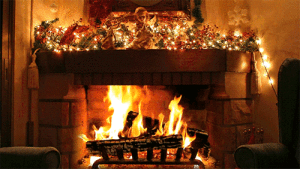
Fire was another major element of the winter solstice for our ancestors but also for us in modern times. I always remember my grandmother’s fireplace going on the night of the solstice much longer than average nights. She may have explained why at some point but she was never one to be really explicit with those old tradition details because she grew up fearful of people knowing our family was involved with “supernatural” things. My grandmother gave me mixed messages that took years for me to sort out because she was part of the church social scene, yet I knew on some level that our traditions weren’t in sync with the church. She did it to throw people off from guessing about us, which was a camouflage method learned from her mother and her grandmother. Sometimes I’ve had to piece things together as an adult because I grew up immersed in things that often went unexplained in direct terms. Liberal use of fire at the solstice was one of those things.

We know today that the Sun will return, because the course of the Sun and the other planets in our system have been scientifically explored. Our ancestors did not take the return of the Sun for granted, and in addition they were suffering much more under the hardships of severe winter weather than we do today. For an agricultural society, whose survival depended mostly on crops, the return of the Sun was not just a matter of casual celebration, it was rather a matter of life or death. (Source.)

In my practice as an adult, fire has taken on a deeper meaning. As I said before, I work with the goddess Brigid. Christianization of Ireland saw Brigid evolve from a goddess into the midwife to the Virgin Mary as she delivered Jesus Christ and she then became a saint. Jesus being among the list of solar savior gods being reborn each winter solstice is no accident and neither is Brigid’s eventual involvement in the folklore because she is a solar goddess. Most ideas of goddesses are connected to the lunar while gods are typically connected to the solar but some, like Brigid, defy those commonalities. While Imbolc is actually Brigid’s festival, many of us do call upon her at the winter solstice if she wishes to convey messages or bless us through our bonfires, Yule logs, and so forth. Fire at the winter solstice coaxes the sun back into life.

The Dagda and Brigid are the deities supposedly connected with the winter solstice. The Dagda was a High King of the Denann. He was associated with Newgrange and the Winter Sun Standing, which is a reference to the position of the sun at the winter solstice. He could control the seasons with his magical oak harp, Uaithne. He was known to the ancient Irish people as ‘the Good God’ and ollathair, which means ‘all-father’, for his warrior-strength, protection, and generosity.

Brigid was his daughter. Her name is thought to mean ‘fiery arrow’, and indeed she was associated with flame in as much as she was a patron of the forge and smith-craft. At her retreat in Kildare, a flame was lit in her honour, and attended by 19 women, who never allowed it to be extinguished. Brigid was extremely well loved by the people, who refused to give her up and accept Christianity. In time, the tending of the flame was taken over and maintained by nuns in honour of the now Christianised St Brigid. (Source.)

Wheat and baking are also part of the winter solstice. Baking was such a huge part of the Decembers in my childhood that it doesn’t feel like this season without cookies, breads, and the fires required to make those things. Nuts and berries were used in a lot of our baking at this time and so was shaping cookies into suns, moons, stars, trees, wreaths, etc. We’ll get into the food in later posts.

I hope that gives you some picture of the things my ancestors passed down through the centuries until it all got to me. It’s not as structured as Samhain for us but it’s more about celebrating how we’re making it through the dark half of the year. For me, it’s also a period to pause and reconnect with Brigid through fire. We usually leave up our greenery decor until January 6th too but I can’t recall the significance behind that. I’ll think of it!

Nollaíg Shona Daoibh!

Read More

Honoring the Dead: My Ancestor Remembrance Ritual

Posted by Jessica Jewett No Comments »

Samhain Ancestor and spirit bonds are the most sacred aspects of Samhain in my tradition. This is my personal ritual shared with you in good faith that you’ll use it responsibly for the remembrance of those who made you who you are today.

You may perform this ritual at your altar, or somewhere else comfortable, or it can be performed at the cemetery with a portable altar. However, it must be stressed that you cannot trespass after cemeteries are closed or in cemeteries where employees might frown upon your ritual work. Any cemetery will do but the magick will be more potent if your ancestors or loved ones are buried there. When in doubt, perform the ritual at home. Do not break the law.

Tools

  • Spirit object
  • Graveyard dirt
  • Offering bowl
  • Three white candles
  • Matches
  • White flowers
  • Method

    Perform the opening of the circle if you do that sort of thing.

    The spirit object should be anything pertaining to your spirit in question–a photograph, an object they owned, or a piece of parchment paper with their full name written on it. Place an offering bowl of graveyard dirt (much better if it’s from the spirit’s own grave but not required) in front of the spirit’s object.

    Place three white candles with matches (I prefer natural implements like wooden matches over lighters). Two candles should be on either side of the spirit object and graveyard dirt with the third candle behind the spirit object. The three candles should form a triangle around the spirit object and graveyard dirt bowl.

    As you light each candle, raise it to the sky and recite the following:

    “Upon this sacred Samhain night, I offer light to honor [Full Name]’s birth.”
    “Upon this sacred Samhain night, I offer light to honor [Full Name]’s life.”
    “Upon this sacred Samhain night, I offer light to honor [Full Name]’s death.”

    (Hint: Irish-speaking people tend to pronounce Samhain as sow-an and some dialects of Gaelic-speaking people have said it’s like sahv-in, sow-een, shahvin, sowin. The Scots Gaelic spelling is Samhuin or Samhuinn. Learn the proper way your ancestors would say it if you’re of Gaelic or Celtic blood.)

    Next you want to take your white flowers. Use your instincts about which type of flowers you think would be best. People in the nineteenth century used white lilies at funerals a lot and I believe carnations were used too. I know Lilies in particular were known as a death flower. If your spirit in question had a favorite flower, use it.

    For my purposes, I prefer white roses in rituals that honor spirits long after the funerary period. White roses are symbols of conveying respect, paying homage, and they express hope for the future, which far better suits this type of remembrance ritual as opposed to remaining caught in the sorrow and grief that lilies and carnations can sometimes conjure. It’s important to maintain the distinction between grieving and remembrance. Grief will hold a spirit back. Remembrance will set it free.

    Hold your bunch of flowers toward the sky. Say, “Upon this sacred Samhain night, I offer flowers to honor [Full Name]’s spirit.” Place the flowers below the spirit object and graveyard dirt offering bowl. Essentially the spirit object and bowl should be at the center of a diamond–lit candles marking the side points and top point with the bunch of flowers marking the bottom point.

    Then recite a prayer, a spell for peace, a poem, or even a song. Since you’re working for the remembrance of an individual spirit or generally remembering all your ancestors, this type of ritual can be personalized. If your spirit had a favorite fitting poem or favorite fitting song, recite the words for them. If you’re not sure, I found this poem online a few years ago and I quite like it for this ritual. You may use it too.

    Do not stand at my grave and weep
    I am not there, I do not sleep

    I am a thousand winds that blow,
    I am the softly falling snow
    I am the gentle showers of rain,
    I am the fields of ripening grain

    I am in the morning hush,
    I am in the graceful rush,
    Of beautiful birds in circling flight
    I am in the starshine of the night

    I am in the flowers that bloom
    I am in a quiet room
    I am in the birds that sing
    I am in each lovely thing

    Do not stand at my grave and cry,
    I am not there, I do not die.

    (Mary E. Frye, 1932)

    Then you should say something to the effect of, “[Full Name], may your spirit know the love and inspiration you’ve given the living upon this Samhain night. Go in peace. I honor thee. So mote it be.” I don’t often say so mote it be since I’m not Wiccan but I figured a lot of you out there are and you can use it. My version is only slightly different. I say, “I honor thee. Through your wisdom, I wish to see. Fare the well until our reunion and great jubilee.”

    Take a moment to meditate in silence as you see fit.

    It’ll then be time to end the remembrance ritual (when you’re ready). When you snuff out each candle, say aloud, “I put out the flame but I don’t put out the light.” Perform the closing of the circle if you do that kind of thing and ground yourself from any excess energy.

    Read More

    Categories