

Yes, I am a witch, and it’s okay!

Posted by Jessica Jewett 2 Comments »

Grimoire - Jessica Jewett Online Just how did I find my path?

The short version of a long story is I was born with natural mediumship and empathic abilities, making several of my childhood priests reject me. I tried to be Catholic for much of my childhood because my grandmother was very concerned about appearances and hiding the things that were different about our family. Since she was good at pretending, I thought, as a little girl, that everyone else was good at pretending too. Asking the wrong questions in Sunday school cause self-worth problems as you might guess though. I got kicked out of Sunday school somewhere around age eleven or twelve because I was asking too many questions about seeing spirits and where Egyptian deities fit in since my mother has always kept tools for Egyptian Magick in the house. I really didn’t understand the divide between women in my family and the Church, yet I kept trying to fit in and be normal.

I don’t really remember how I started going into the natural way (my mother always used this phrase the natural way but I never knew it was different). My best recollection was feeling rejected by Christianity and naturally drifting into what my mother and grandmother already lived despite my grandmother confusing me with a public mask of a perfect churchgoing woman.

When I finally opened up about the things I could do around puberty (spirit encounters, feeling other people, etc.), I found out that every other woman in my family has different abilities too. Even some of the men have been naturally gifted. My mother is a medium, as is my grandmother, and so on and so forth. My grandmother can also see auras and she has precognitive sight. I started doing genealogy as a separate interest and soon found documents (letters) written by other maternal ancestors in which they spoke among themselves about communication with spirits, herbs, holistics, writing prayers as poetry (?), and other things that I’m still trying to understand. My maternal line is divided between Ireland, England, France, and Germany, but most of the “natural” people seem to have come from England and Ireland.

Nobody in my family ever used the word “witch”. My grandmother, at best, referred to herself as a healer sometimes and a sensitive at other times. Despite presenting herself as a churchgoing woman, there were always books about how to use herbs, plants, dream interpretation, astrology, and so forth. I learned the importance of the moon cycle and how to properly interact with it from both my grandmother and my great-grandmother, yet nobody ever used words like “witch” or “paranormal”. She always had strange cures for things that I used to roll my eyes at when I was little even though the things she did to me always worked. She said she learned a lot of it from the African-American sharecroppers on her Missouri farm in the 1950s as well as her own mother and grandmother during the Depression and skills acquired from much further back.

My best guess is that my maternal line is full of “witches” going back before America was a country. The way I grew up, following moon cycles to do or not do things in everyday life, knowing about plants, herbs, animals, knowing about the other world, knowing “god” was female as much as male, etc.–it was all the natural way. That’s what they called it. My mother in particular always looked at Christian church as unnatural and something to be avoided but she never stopped me from exploring it. She always told me to find my own way and, as it turns out, my own way is in the footsteps of my family members who came before me.

I’ve been in and out of dedicated learning and practice since I was about fourteen. I’m thirty-two now. I don’t really know what kind of witch I am yet but I’m learning that Wicca doesn’t exactly fit with what my family believed. There was never any mention of the threefold law or the rede, for example. All mentions of higher powers, deities, spirits, etc., always sound like they’re right here among us as opposed to a far off place in the sky. That’s what I know to be true as well from my own experiences. I don’t think what we’ve been doing is Wicca since that seems to be relatively new. My family history with this kind of thing goes back to rural people in France, England, Ireland that intermarried once they came to North America in the 1600s and 1700s. I’ve heard it called folk magick in some places and Celtic witchcraft in others and traditional UK witchcraft in still others. I’m not so sure labels matter all that much as personally carrying on traditions and skills that I’ve been learning my entire life.

Unfortunately, my granny has been suffering from dementia for about ten years. I have no one to teach me on a deeper level, so I’m learning on my own. That’s even harder down here living in the Bible belt.

(To view my blog specifically about being a witch, please follow The Witch in a Wheelchair.)

Read More
Planning a Samhain feast

Posted by Jessica Jewett No Comments »

Samhain is probably one of those holidays that most people don’t even realize is vastly Pagan in tradition. The evolution of Halloween is one of the clearest routes of insight into the merging of Pagan traditions with other traditions throughout the world, especially Christianity. As I have been helping people see what a Samhain feast could be like, I find myself getting tangled in more modern Halloween party websites. The lines between Samhain and Halloween are very blurred.

For more information about Samhain, please refer to my blog called, “Samhain, the witches’ new year” posted on October 17, 2011.

Roasted Chestnuts

There is something about roasted chestnuts that just means the end of summer has arrived.

To roast 2 1/4 pound chestnuts:

Preheat the oven to 400 F. Using a small, sharp knife cut a cross into the skin of each nut. Put in a roasting tin and bake in the oven until the skin opens and the nut inside is tender. This takes about 30 minutes. To eat, peel away the tough outer skin and the white inner layer. I have found that it is much easier to peel away this outer skin if you do it while the chestnuts are still quite warm.

Note – If you try to roast the chestnut without cutting the skin, it will try to burst open anyway. But the chestnut is likely to burst open quite explosively. Save the mess in the oven and the risk of injuring yourself and make sure the skin has been cut on each nut.

Harvest Vegetable Soup

Serves 6
Prep: 15 minutes
Cook: 30 minutes

Ingredients
1 oz butter
1 leek, trimmed and sliced into 1/2 rings
1 onion, finely chopped
1 courgette (zucchini), chopped
8 oz swede or turnip, diced
1 large carrot, diced
1 medium potato, diced
1.5 pints vegetable stock
3 Tbsp cornflour (cornstarch)
1 pint milk
3 oz sweetcorn, thawed if frozen
chapped fresh parsley, to garnish

Melt the butter in a large saucepan and sauté the leek, onion, and courgette over a medium heat until softened (about 3 – 4 minutes). Add the swede or turnip, carrot and potato. Continue to cook, stirring frequently, for another 2 – 3 minutes. Pour in the stock and cook gently, covered, for about 15 – 20 minutes, or until the vegetables are tender. Blend the cornflour to a smooth paste with 3 – 4 Tbsp of the milk. Add the remaining milk to the saucepan with the sweetcorn, then stir in the blended cornflour. Heat gently, stirring constantly until the soup thickens and just begins to boil. Cook for another 1 – 2 minutes over a very low heat. Season to taste and then ladle into warm bowls. Serve, garnished with chopped fresh parsley and crusty bread. If desired, you could add cooked chicken or a tin of beans to this soup to make it a full meal.

Pork Roast

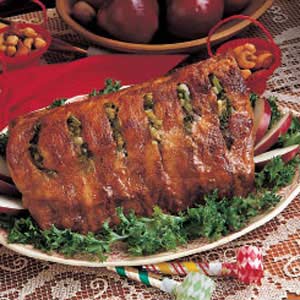
Take the pork from the fridge and dry it thoroughly. Let it sit out for at least an hour. Using a sharp knife, slice the skin halfway through the layer of fat into a diamond pattern. Be very careful not to cut the string holding the roast together. Take a tablespoon of salt and rub that into the skin.

The roast must be as dry as possible. Cutting the skin and into the fat allows the fat to be released while the pork is cooking. It also makes it easier to eat the crackling afterwards. The salt also serves to help release the fat and pull out any remaining moisture.

Preheat the oven to 400F. Roast it in the oven, without covering, for the specified time. It works out to 25 minutes per pound + 25 minutes. Take it out halfway through cooking and rotate the joint. The pork is done when the juices run clear.

Very important – Do not baste the pork joint.

Gourmet Sweet Potatoes

Prep time: 20 minutes
Cook time: 1 hour 25 minutes
Serves 8.

Ingredients
    5 sweet potatoes
1/4 teaspoon salt
1/4 cup butter
2 eggs
1 teaspoon vanilla extract
1/2 teaspoon ground cinnamon
1/2 cup white sugar
2 tablespoons heavy cream
1/4 cup butter, softened
3 tablespoons all-purpose flour
3/4 cup packed light brown sugar
1/2 cup chopped pecans

Preheat oven to 350 degrees F (175 degrees C). Lightly grease a 9×13 inch baking dish. Bake sweet potatoes 35 minutes in the preheated oven, or until they begin to soften. Cool slightly, peel, and mash.

In a large bowl, mix the mashed sweet potatoes, salt, 1/4 cup butter, eggs, vanilla extract, cinnamon, sugar, and heavy cream. Transfer to the prepared baking dish. In a medium bowl, combine 1/4 cup butter, flour, brown sugar, and chopped pecans. Mix with a pastry blender or your fingers to the consistency of course meal. Sprinkle over the sweet potato mixture. Bake 30 minutes in the preheated oven, until topping is crisp and lightly browned.

Herbed Corn

Prep time: 20 minutes
Serves 10.

Ingredients
    12 cups frozen corn
1 cup water
1/2 cup butter, cubed
2 tablespoons minced fresh parsley
2 teaspoons salt
1 teaspoon dill weed
1/2 teaspoon garlic powder
1/2 teaspoon Italian seasoning
1/4 teaspoon dried thyme

In a large saucepan, combine corn and water. Bring to a boil. Reduce heat; cover and simmer for 4-6 minutes or until corn is tender. Drain; stir in the remaining ingredients.

Rye Bread
Ingredients
1 packet yeast
1 tablespoon sugar
1/4 cup warm water
1 quart warm water
3 cups rye flour
2 tablespoons salt
3 tablespoons caraway seeds
1 tablespoon melted shortening
9 cups all purpose flour

Dissolve yeast and sugar in the 1/4 cup of warm water, set aside and let stand until frothy. Pour the quart of water in a large bowl, and add the rye flour, salt, caraway seeds, shortening, and yeast mixture. Mix well. Let rise in a warm place for 1 1/2 hours, until bubbles start to form on dough’s surface. Gradually mix in the all-purpose flour, until the mixture has become a firm dough. Knead on floured board for about 10 minutes. Place in a greased bowl and let rise until the dough doubles in size, about 1 1/2 to 2 hours. Knead again for 10 minutes. Form into 2 loaves and put in greased and floured loaf pans or on cookie sheets for a more natural look. Let them rise again until doubled in bulk, and then bake for 1 hour at 375 degrees.

Mulled Wine

Mulled wines are a traditional favorite, no matter what the occasion, but Halloween presents a terrific opportunity to introduce others to its appeal. The Banshee Mulled Wine recipe is a warm wine punch sure to clutch the palate of all Halloween gouls.

Prep Time: 5 minutes
Cook Time: 25 minutes
Total Time: 30 minutes

Ingredients
    One bottle of red wine (suggestions: Cabernet Sauvignon, Zinfandel, Merlot or a Spanish red)
One peeled and sliced orange (keep peel to add zest to taste into cooking pot)
One peeled and sliced lemon (keep peel to add zest to taste in cooking pot)
1 tsp ground nutmeg
2 tsp ground ginger
5 whole cloves
3 cinnamon sticks
1/2 cup sugar (or honey can be substituted)
2/3 cup brandy or cognac
1/2 cup water

Combine all ingredients in either a large pot or a slow cooker. Gently warm the ingredients on low to medium heat (avoid boiling), for 20-25 minutes. Stir occasionally to make sure that the honey or sugar has completely dissolved. When the wine is steaming and the ingredients have blended well it is ready to serve. Ladle into mugs (leaving seasonings behind), garnish with a blood orange segment and perhaps black plastic, Halloween spiders and enjoy!

Country Apple Dumplings

Prep time: 20 minutes
Cook time: 45 minutes
Serves 16.

Ingredients
    2 large Granny Smith apples, peeled and cored
2 (10 ounce) cans refrigerated crescent roll dough
1 cup butter
1 1/2 cups white sugar
1 teaspoon ground cinnamon
1 (12 fluid ounce) can or bottle Mountain Dew

Preheat the oven to 350 degrees F (175 degrees C). Grease a 9×13 inch baking dish. Cut each apple into 8 wedges and set aside. Separate the crescent roll dough into triangles. Roll each apple wedge in crescent roll dough starting at the smallest end. Pinch to seal and place in the baking dish. Melt butter in a small saucepan and stir in the sugar and cinnamon. Pour over the apple dumplings. Pour Mountain Dew over the dumplings. Bake for 35 to 45 minutes in the preheated oven, or until golden brown.

Read More

Apples for Samhain

Posted by Jessica Jewett 1 Comment »
Samhain is probably one of those holidays that most people don’t even realize is vastly Pagan in tradition. The evolution of Halloween is one of the clearest routes of insight into the merging of Pagan traditions with other traditions throughout the world, especially Christianity. As I have been helping people see what a Samhain feast could be like, I find myself getting tangled in more modern Halloween party websites. The lines between Samhain and Halloween are very blurred.

For more information about Samhain, please refer to my blog called, “Samhain, the witches’ new year” posted on October 17, 2011.

When the Romans came to Britain, they brought with them their November 1st festival honoring Pomona, goddess of fruit trees. The Celts considered the apple tree to be particularly worthy. In fact, the growth cycle of the apple was considered such a miraculous thing that Avalon, (the land where spirits of the dead dwelled) was thought to have an abundance of apple trees bearing fruit year round. Apples also played a major role in divinations on Samhain. Apple peeling was a divination to see how long your life would be. The longer the unbroken apple peel, the longer your life was destined to be.

Apples and hazel nuts that played an especially important part to the early Celts: they were foods of the Otherworld, were notably used. Hazel nuts were known as a source and symbol of wisdom, and were eaten before divination. The apple symbolized life and immorality, was the talisman that admitted one to the Otherworld, and gave one the power to tell the future. At the heart of the Celtic Otherworld grows an apple tree whose fruit has magical properties. Old sagas tell of heroes crossing the western sea to find this wondrous country, known in Ireland as Emhain Abhlach, (Evan Avlach) and in Britain, Avalon. At Samhain, the apple harvest is in, and old hearthside games, such as apple-bobbing, called apple-dookin’ in Scotland, reflect the journey across the water to obtain the magic apple.

There are two main apple rites that survive, one involves ordeal by water and the other ordeal by fire. The act of going through water to obtain apples could be the remnants of the Druidic rite symbolizing the passing through water to Emain Abhlach or Apple-Isle. Apple-Isle is where Manannan Mac Lir prepared the Otherworld feast for the eternal enjoyment of those who have passed on.

The Ordeal by Water survives in Scotland in such Samhain traditions as “Dookin’ for Aipples.” A large wooden tub is filled with water and set in the middle of the floor into which apples are placed. The master of ceremonies has a porridge stick or some other equivalent of the Druidic wand, and with this he keeps the apples in motion. Each participant get three tries, and if unsuccessful, must wait until the others have had their turn. If a participant captures an apple, it is either eaten or kept for use in another of the divination rites.

The modern form of the Ordeal by Fire is known as “The Aipple and the Can’le.” A small rod of wood is taken and suspended horizontally from the ceiling by a cord. After it is fairly balanced, a lit candle is set on one end and an apple at the other. The rod is then set whirling around. Each of the company takes turns leaping up trying to bite the apple without singing his or her hair.  Touching either the rod or apple with the hands is not permitted.

The divinations practiced at Samhain were chiefly used to discover who would marry, who one’s partner was going to be, and who was going to die over the course of the next year. Eating the Apple at the Glass is an example of such a divination. At the hour of midnight the person goes into a room with a mirror. The room is lit with but one candle. The apple is cut into nine pieces. The person stands with his or her back to the mirror, eats the eight pieces, and throws the ninth piece over the left shoulder. Turning towards the mirror, he or she will see the future partner.

Paring the Apple is another Samhain divination rite performed at the stroke of twelve. The person pares the apple carefully so that the skin comes off in one unbroken ribbon. As the clock strikes twelve the person swings the paring around his or her head three times with out breaking it, and tossing it over the left shoulder. The shape that the paring assumes is the initial of the querant’s future spouse. If the paring breaks matrimony will not happen in the coming year.

Candied Apples

Prep time: 10 minutes
Cook time: 30 minutes
Serves 15

Ingredients
    15 apples
2 cups white sugar
1 cup light corn syrup
1 1/2 cups water
8 drops red food coloring

Lightly grease cookie sheets. Insert craft sticks into whole, stemmed apples. In a medium saucepan over medium-high heat, combine sugar, corn syrup and water. Heat to 300 to 310 degrees F (149 to 154 degrees C), or until a small amount of syrup dropped into cold water forms hard, brittle threads. Remove from heat and stir in food coloring. Holding apple by its stick, dip in syrup and remove and turn to coat evenly. Place on prepared sheets to harden.

Caramel Apples

Prep time: 5 minutes
Cook time: 45 minutes
Serves 5

Ingredients
    5 large Granny Smith apples
wooden craft sticks
1 (14 ounce) package individually wrapped caramels, unwrapped
2 tablespoons water
7 ounces chocolate candy bar, broken into pieces
2 tablespoons shortening, divided
1 cup colored candy coating melts

Bring a large pot of water to a boil. Dip apples into boiling water briefly, using a slotted spoon, to remove any wax that may be present. Wipe dry, and set aside to cool. Insert sticks into the apples through the cores. Line a baking sheet with waxed paper and coat with cooking spray. Place the unwrapped caramels into a microwave-safe medium bowl along with 2 tablespoons of water. Cook on high for 2 minutes, then stir and continue cooking and stirring at 1 minute intervals until caramel is melted and smooth. Hold apples by the stick, and dip into the caramel to coat. Set on waxed paper; refrigerate for about 15 minutes to set. Heat the chocolate with 1 tablespoon of shortening in a microwave-safe bowl until melted and smooth. Dip apples into the chocolate to cover the layer of caramel. Return to the waxed paper to set. Melt the candy melts in the microwave with the remaining shortening, stirring every 30 seconds until smooth. Use a fork or wooden stick to flick colored designs onto your apples for a finishing touch. Refrigerate until set, overnight is even better.

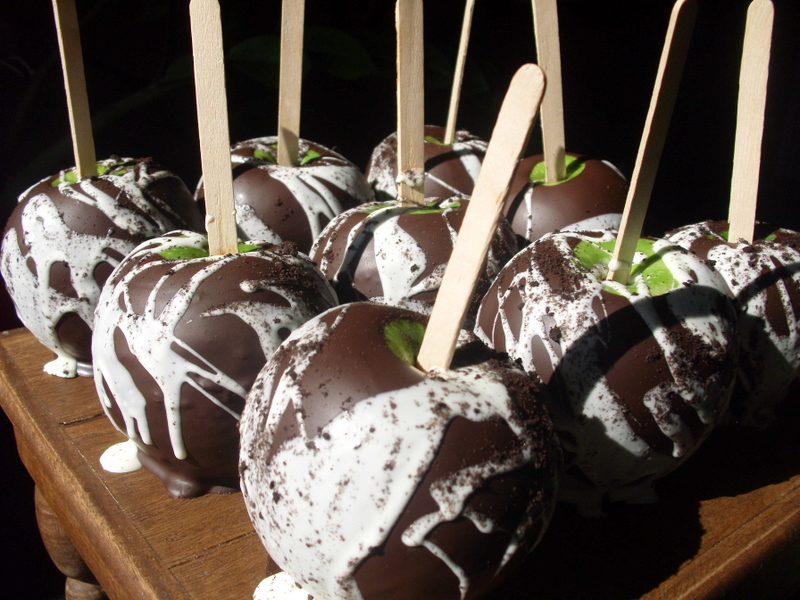
Chocolate Dipped Apples

Prep time: 30 minutes
Cook time: 1 hour
Serves 10

Ingredients
    10 small Granny Smith apples
1/2 cup chopped roasted peanuts
1/2 cup candy-coated milk chocolate candies
2 pounds semisweet chocolate, chopped

Insert wooden craft sticks or lollipop sticks into the cores of the apples at the stem. Place the roasted peanuts and candies on separate plates. Set aside. Place the chocolate into a metal or glass bowl and set over a pan of barely simmering water. Stir frequently until melted. Remove from the heat. Dip apples into the melted chocolate, turning to coat completely. Dip or roll in candy or nuts, then place on a sheet of waxed paper. Repeat with remaining apples. Allow apples to set at room temperature until the chocolate is firm, about 20 minutes, before serving.

Read More

Categories