



>Dressgasm of the Day: 1774 Wedding Dress

Posted by Jessica Jewett 4 Comments »

>

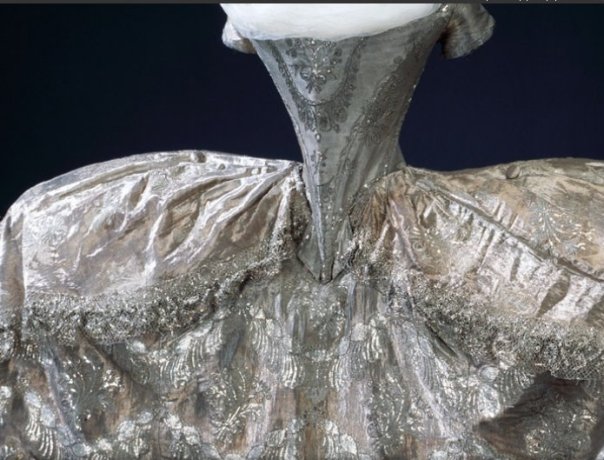
This could quite possibly be the most epic dressgasm I’ll ever post. This sculpture of a gown, more of a work of art rather than a dress, was the wedding dress of Edwige Elisabeth Charlotte de Holstein-Gottorp. She was French, as I recall (please correct me), and this wedding gown was made for her to marry Prince Karl of Sweden in 1774. Upon her marriage, she became the sister-in-law of King Gustave III of Sweden. This was happening at the same time of Marie Antoinette’s rise to power in France and she later gave a painting of herself and her children to King Gustave. Additionally, it has been hotly debated as to whether Marie Antoinette had an affair with a Swede who was a confidante of his own king, as I recall. These royal families were all intertwined and related to one another throughout Europe.

Gowns of the European court were massive in the eighteenth century and not at all representative of what the regular population wore. Fabrics of the super-rich were threaded with real silver and gold, accented with intricate laces, embroidery and many gowns had actual jewels sewn into them. It was a very romantic and naive period of history in which women were beautiful pieces of adornment like a fabulous piece of furniture or a delicious ostentatious cake. As economy, philosophy, education and social debates arose in Europe and the Colonies, the romance faded somewhat and the size and scope of these gowns faded with it.
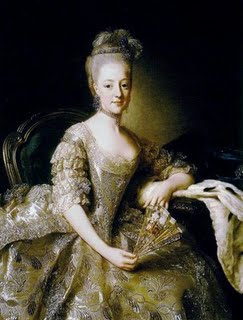
And here is a painting of Edwige Elisabeth Charlotte de Holstein-Gottorp wearing the above wedding dress.
Read More

>Dressgasm of the Day: 1860s Maternity Dress

Posted by Jessica Jewett 2 Comments »

>

Today’s dressgasm is not exceptional in its beauty or design but it is extremely unique in that it’s both a maternity dress and it’s such a dark color. I don’t know a lot about the background of this dress since I think it was a picture lifted from an old eBay listing (I could be mistaken though).

The dress is either black, faded and stained in some places, or it’s a charcoal or navy color. Sometimes it’s difficult to tell when the aging of the fabric can sometimes alter the color’s original depth and intensity. The sleeves appear to be modified coat sleeves with black trim and the same black trim can be found along the front of the dress and around the lower foot of the skirt. I can’t quite tell what type of fabric that makes this dress but my best estimate is it might be silk taffeta or a silk wool blend or a silk cotton blend. If it’s not some type of silk, I would be surprised, because heavier fabrics don’t typically wrinkle or crinkle like that from what I have seen in the past.

It’s not so common to find in tact maternity dresses from the nineteenth century because most women didn’t have the money or the resources to have new dresses made for when they were pregnant. In most cases, women altered existing dresses for the pregnancy and then altered the dresses again when they lost the baby weight. Women spent a great deal of their married lives either pregnant or nursing so they also spent a lot of time in confinement. It was inappropriate for a woman to be out in public if she could possibly help it once the pregnancy was too far advanced to hide the baby bump. A lot of women just wore their house dresses, which were loose-fitting dresses usually in paisley or calico for most people and better material for the rich. For that reason, most house dresses can be advertised as possible maternity dresses as well but because they were so loose, it’s very difficult to tell if they were actually used during pregnancy or not.

This particular maternity dress is odd to me because it’s so dark and it looks more like a DRESS than a house dress. I think this lady must have had some money or she never re-altered the dress after the pregnancy was over. The lace trim and stripe trim cost money for just a house dress or a temporary garment to be worn around the house in confinement. Was this lady vain? Was she rich? Or could she possibly have died before she had a chance to take the dress in after birth? Childbirth was the leading cause of fatality among women and the child mortality rate was sky high. One thing is clear: this maternity dress speaks of mystery to me and that’s why I chose it.

Read More

>Dressgasm of the Day: Late 1860s Silk Brocade

Posted by Jessica Jewett 1 Comment »

>

Today’s dressgasm of the day is a rare specimen from the later part of the 1860s. It’s listed on eBay right now for a pretty penny and the seller estimates the year to be 1867. What makes it rare is the fact that the matching bonnet survived, in tact, with the dress after decades and decades. The dress is made of striped silk brocade in a cocoa color and it is two pieces — a bodice and a skirt — rather than a one piece dress. There were dresses for almost every daily activity in the upper class and this dress appears to me to be a visiting or walking dress. The sleeves appear to be modified coat sleeves, which were narrow and closed at the cuff as opposed to the wide bell-shaped pagoda sleeves of the 1850s.

The best way to date a dress in the 1860s is by looking at the shoulder seams. Early in the decade, the shoulder seams fell a few inches below the natural shoulder to give the illusion of width so the waist would look smaller. As the decade progressed, the shoulder seams crept higher and higher until they were straight up and down by the end of the decade.

The bonnet is a good example of a half bonnet from the late 1860s that preceded the bonnets of the 1870s. As the nineteenth century progressed, bonnets went from wide-brimmed, head-swallowing contraptions to small decorations resting on top of the head. This example of late 1860s design is a woven straw bonnet over a wired frame with a tulle lining, fruit-like cloth accents, flowers and bows. There is also a pre-made bow to the chin ties. Straw bonnets with false flowers and decorations were probably the most common type of bonnet used by all classes. Wealthier women expressed themselves through more intricate decoration and better materials.

Read More

Categories