

>Dressgasm of the Day: 1849 Candy Cane Dress

Posted by Jessica Jewett 1 Comment »

>Today we have a rather festive dress for the dressgasm that looks like a candy cane to me. The search for Christmasy dresses was turning up very little results in my look at Google. I believe that’s because most people could not afford to have a dress made just for one holiday out of the year, so they simply wore their best church dresses.

I found this dress from the Victoria and Albert Museum in England, as I recall. The listing said the dress was made of damask, a type of silk, and I found that odd because damask was typically used for upholstery and linens in my understanding of the types of silk. It was a wedding dress as opposed to a holiday dress. At the time, white wedding dresses were not the requirement that they are today so a woman typically wore, again, her best church dress and reused it. I am, however, surprised that this dress was worn by a bride when it has red stripes because red was the color of a woman who wanted attention. Some believed red was the color of a harlot or a flashy woman, both which were very undesirable qualities, especially for a bride. It’s possible that it was for a second wedding but even then, I have never seen evidence of another bride from that period wearing red.

This dress is from 1849. The best way to date 1840s dresses as opposed to 1860s dresses is to look at the characteristics of the waistline, the shape of the skirt and the shape of the bodice. Waistlines of the 1840s were almost always pointed and at or slightly below the natural waistline, and as the 1850s progressed, the waistline rose higher and higher. By the 1860s, the waistline was about two inches above the natural level. The cage crinoline was not used until the 1850s so the skirts of the 1840s tended to be narrower with only petticoats to fill their width. The bodice of the 1840s was extremely tight and fanned upward in a decidedly V-shape as well.

Read More
>Dressgasm of the Day: 1860s Copper Silk

Posted by Jessica Jewett No Comments »

>

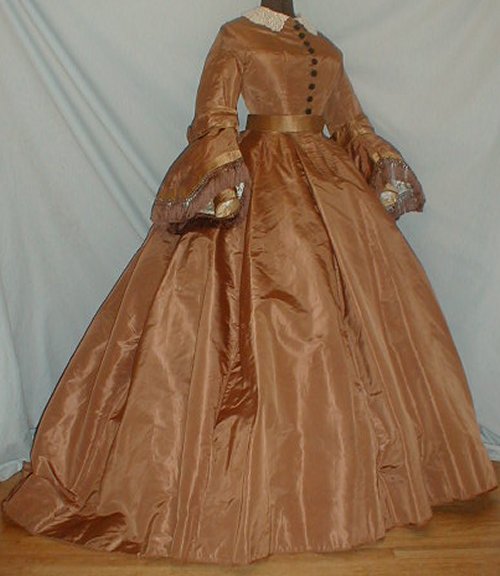
Today’s dressgasm is epic by my standards. To the untrained eye, it looks like a typical visiting dress from the Civil War period but there are some very unique design elements that I find fascinating.

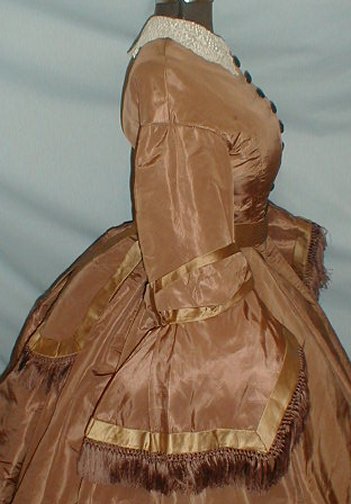
This dress is a two-piece silk visiting dress (we discussed the purpose of visiting dresses in an earlier dressgasm blog) and a two-piece dress is the bodice and then the skirt with the waistband attached. Sometimes two-piece dresses were held together like a pseudo-one-piece with hooks and eyes at the waist. This woman had a 24-inch waist and I believe the dress length from collar to hem was something like 41 inches. Copper, bronze and brown were extremely fashionable colors in the mid-nineteenth century so this dress was the height of fashion.

What makes this dress so unique to me is the sleeves. I would term it as modified pagoda. Normally pagoda sleeves are bell-shaped and start at the elbow but it appears that these sleeves start fanning out at three-quarter length. Not only that but the embellishments are of unique design as well. It looks like there are satin ribbon bands around the arm and then around the edges with silk fringe. If you look in the picture above, it appears that there are attached undersleeves of the same copper silk material. That is very unique. I can’t think of another example of a design like that and my images of antique clothing number in the thousands. Under normal circumstances, the undersleeves would not be attached and they would be white like the collar. Undersleeves were removable for washing and were worn to protect the dresses from bodily oils and dirt, as these dresses were not easily or often washed.

Read More

>Dressgasm of the Day: 1860s Interchangeable Dress

Posted by Jessica Jewett No Comments »

>

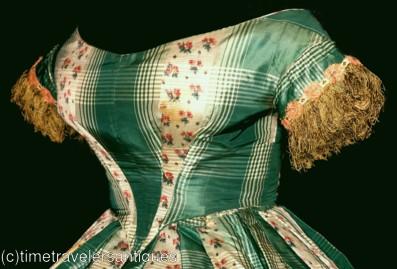
This lovely ballgown on the left is today’s dressgasm but it’s not the whole dress, so I thought I would use today to talk about interchangeable dresses. This piece came from another eBay auction over a year ago from one of my favorite sellers but I don’t know a lot about the history of it, where it came from or who wore it originally.

I date the dress to about 1863 based on the pointed waist at a higher level than the natural waist, the dropped shoulder seams and the shape of the skirt. The fabric is most likely some type of silk with alternating stripes of green and white plaid and little red roses. Gold fringe borders the sleeves and their short length tells me that this is a ballgown, although there is very little trim and decoration. The lady was probably of either simple taste or she put trim on her dress that was removable like fresh or false flowers.

People were frugal in the Victorian period even if they were wealthy. This fabric would have been pretty expensive even if it was made of cheaper fibers because of the intricate and large design. The larger the design, the more fabric had to be bought because it would take more to get the seams to match up. A woman would naturally want to show off her pretty fabric but limiting it to the occasional ball wouldn’t get full use out of it. Interchangeable bodices became popular. With an extra two or three yards, the woman could have a daytime bodice made that would allow her to make the most of her clothes. It was like getting two dresses for the price of one.


Read More

Categories