

>Dressgasm of the Day: 1860s Polonaise Visiting Gown

Posted by Jessica Jewett 2 Comments »

>

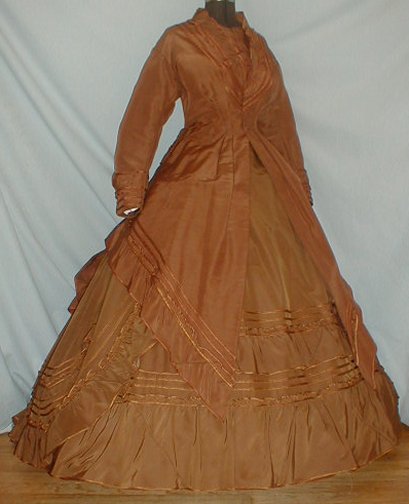
Today’s dressgasm is so stunning exclusively because of the unique design of the extended points from the bodice and the flattering draping of the skirt. I found this dress in an eBay listing this morning from one of my favorite sellers of antique garments.

This dress dates to the mid-1860s from my estimate. If I had to put a year on it, I would say 1864 or 1865, possibly even 1866, based on the draping of the skirt and the cut of the bodice. The width of the skirt suggests Civil War but the cut of the dress looks like a precursor to the bustle dresses of the 1870s and 1880s. It’s a silk and wool blend in a copper color that becomes gold when the fabric is hit by different light. Bronze satin ribbon lines the drapes and ruffles on the skirt and bodice.
A woman wore a “visiting dress” when she did just that — visited her friends and family. As I wrote in an earlier blog post, wealthier women had different dresses for a myriad of different purposes not only for functionality but to put her social status on display. A certain portion of the day would have been reserved for opening the house so a woman could receive guests. The woman who wore this dress did so when she was out visiting people that she probably wanted to impress. If you made a call on someone who wasn’t home, then you could leave your calling card and that way, the friend or whomever could answer you with a note later or invite you back another day. This was such a lovely dress that the lady might have thought about having her photograph made in it. When you had a photograph made, you wore your better clothes because it was considered a special occasion.

Read More

>Dressgasm of the Day: 1895 Boston Ballgown

Posted by Jessica Jewett 1 Comment »

>

Have you ever heard that all fashion styles recycle themselves in time? Today’s dressgasm comes from 1895 but it also looks like it could have been a 1985 prom dress, except this dress is exceedingly well-designed and expensive. A polyester or rayon prom dress discarded after a night of drinking and dancing, it is not, but it resembles the princess dresses we all wore in the 1980s.

This ballgown is listed on eBay at the moment and it is another acquisition from a museum. The gown is said to have been owned by Blanche Goodhue-Pfaeltzer, who lived in Boston and Paris, and the label inside says Maison Truffert, San Francisco, which was a dressmaker on Taylor Street according to a reference in 1890. This dress in particular is dated to 1895 and it would have been considered fabulous Boston high-end fashion. If Blance had residences in Boston and Paris, then she certainly had a good deal of wealth at her disposal.

Golden silk satin makes up most of this ballgown along with a brocade bodice. The end of the nineteenth century into the early twentieth century saw the most severe synching with corsetry at the most unhealthy levels. Blanche’s golden ballgown has a bust of 31 inches and a mind-boggling waist of 21 inches, which is not even the smallest I have seen from that decade. The gown is of all French construction with a lace-up back and a bodice lined and stayed (like boning) to give even more structure over a corset. What makes this dress even more unique is that the shoes and stockings are still with it. The stockings are made of golden silk and the shoes are high heeled and made of satin. If only 1980s prom dresses were this lovely!


Read More

>Dressgasm of the Day: 1856 Green 3-Tier

Posted by Jessica Jewett 2 Comments »

>

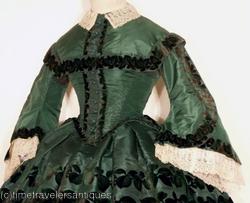
This whopper of a dress on the left is the dressgasm of the day. It was sold on eBay a few months ago after the seller acquired it from a museum in the Northwest, as I recall. It sold for a mind-bloggling price of $1,275, but the dress is absolutely worth every penny considering the great condition. The lady who wore this dress was tiny. Keep in mind she was wearing a corset and the dress had stays sewn in as well but the bust was only 31 inches and the waist was only 24 inches. Her natural waist without the corset was most likely about 26 or 27 inches. Let me put that into perspective. I am five feet tall on the dot and my measurements fluctuate between 32 and 34-inch bust and 28 and 29-inch waist. With a corset, I get no smaller than a 27-inch waist. This woman was probably no taller than 5’2 and the average height for a woman in 1860 was between 5’0 and 5’2, so if you look at me, I’m about average for that time. I fit into a lot of these dresses but even I’m too “fluffy” for this dress.

This dress is made of forest green silk taffeta. This is clearly a mid-to-late 1850s dress because of two hallmarks: the multi-tiered skirt and the pagoda sleeves. While these things carried into the 1860s, they were far less prevalent as the blockades limited fabric importing and all efforts and resources were put into feeding, clothing and arming the armies. Black velvet foliage patterns line the edges of the skirt tiers and the sleeves. The trim around the collar and sleeve cuffs is called point de gaz. This woman was clearly quite wealthy if she could afford silk taffeta in that quantity and intricate and unique black velvet trim on top of it. It is a quality piece in structure since there has been very little serious damage between 1856 and 2009. It probably had some machine stitching when it was made.


Read More

Categories