
>Imbolc – Festival of the Goddess Brigid

Posted by Jessica Jewett No Comments »

>

Right now we are in the season of Imbolc, which is a sabbat usually celebrated in the first few days of February, along with my birthday. This is my season. I don’t think it’s a coincidence that I have begun studying the Old Religion in the season of my birth. I also find that I identify with the goddess in which this season honors. Her name is Brigid (with varying spellings over the years in different cultures). When I was studying the different sabbats and the Wiccan calendar in this blog, I briefly touched on Brigid’s role in Imbolc and I immediately felt the pull to study her further.

I think Brigid is very revered and honored today because she has several faces (quite literally) and manages carrying herself in a masculine world, much like women in this modern age. She is so revered that she was a pagan goddess that became a Catholic saint. St. Brigid’s Day is February 1, which was typically the festival of Imbolc. Brigid originates in Irish mythology. Her name means “the exalted one” and she was the daughter of the Dagda, who was a very important god of Irish mythology as well, being known as “all-father” and the protector of the tribe. She had two sisters, also named Brigid, and therefore, this makes her known as the triple goddess, often depicted with three faces. She has two oxen, Fe and Men, a boar known as the king of boars present in Arthurian legend, and the king of sheep too. For this reason, she is associated with sheep and other animals that begin the rebirth season during Imbolc. The word Imbolc comes from the lactation of the ewes, the flow of milk that heralds the return of the life-giving forces of spring. Later, the Catholic Church replaced this festival with Candlemas Day on February 2, which is dedicated to the Virgin Mary and features candlelight processions. The powerful figure of Brigid the Light-Bringer overlights both pagan and Christian celebrations.
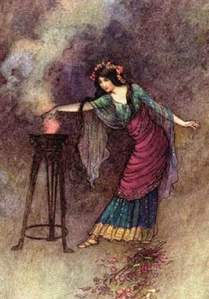
Brigid’s divine responsibilities are many and varied. She is considered a mother goddess and goes back as far as the word brihati in Vedic Sanskrit, which is an epithet of the divine. Her wisdom is vast, being the one to inspire and protect poets. In her time, poetry was associated with seers and that made her seen as the great inspiration behind divination and prophecy, the source of oracles. Given my profession, I found that rather interesting.

Her two sisters are Brigid the Physician and Brigid the Smith but it seems to me that the three sisters are basically just three facets to the same triple goddess. She is a healer and a master of the flame in these other two faces of her existence. When Christianity came to Ireland, this goddess was transformed into a saint who was able to miraculously increase the milk and butter production from cattle in Kildare. Interestingly enough, my ancient Irish ancestry came from Kildare! Brigid is my lady! There are lengthy legends and tales about Brigid being the keeper of the flame and it extended fully into her incarnation of Saint Brigid as well. The fire, the light in association with the festival of Imbolc involves giving hope that the death of winter will soon be over and the rebirth of spring will soon come. Candlemas was celebrated in Christianity all the way up until the Reformation. Again we see symbols of light chasing away the darkness for humanity. The third side to Brigid is her ability to heal and many healing wells and springs are named after her in Ireland.

In the celebration of Imbolc, it’s time to clean your home and remove everything associated with Yule, the season prior to Imbolc. Beginning on February 1, it is appropriate to make Brigid’s crosses out of rushes or straw and hang them mainly in the kitchen where your food will be blessed. The crosses can also protect your home from fire and evil, should Brigid choose to bless you. Also on February 1, it is appropriate to put offerings of milk, bread, butter and cake outside of your door for Brigid and her cow as they walk through your neighborhood that night. Also leave a silk ribbon on your doorstep for Brigid to bless that night and you will be able to use it later for healing purposes. Meditation upon the issues of growth in health and strength in the coming year for yourself, your family, your community, the planet, the universe, etc., and asking Brigid for her blessing in those endeavors is also necessary during the Imbolc season. Put candles in your windows as symbols of the rebirth of the sun. Honor the Maiden as she prepares to be a bride by decorating your home with white flowers and offering them to her.

Read More
>The Wheel of the Year

Posted by Jessica Jewett No Comments »

>

As I announced before, I have made the decision to devote myself to the study of the Old Religion because it feels more natural with my existing convictions. For right now, I’m studying as a solitary practitioner. I’m sure I will join a coven at some point; most likely the House of RavenStone here in Atlanta. I find I learn better if I rewrite things in my own words, so I will occasionally write about things I’m learning here in my blog.

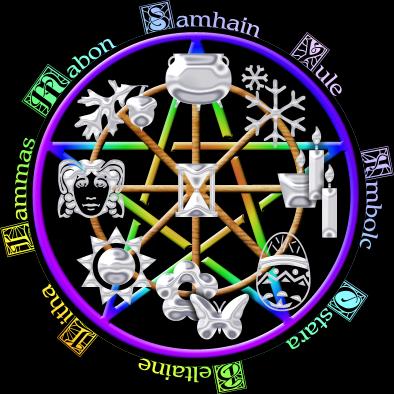
Today I have been learning the Wheel of the Year, which is basically the Wiccan calendar. It is divided into eight sabbats that honor and celebrate the earth’s natural cycle of seasons. Within the year, there are thirteen full moon celebrations as well, which are called esabats. Once you learn the pattern of the calendar and recognize the natural flow of it (as well as the obvious holiday thievery by early Christians), you see that it makes more sense than any calendar of holidays today. This is based on celebration of the seasons, equinoxes and solstices. Eostra (also called Ostara) and Mabon are the spring and fall equinoxes. This is when day and night are equal in length. Yule and Midsummer are the winter and summer solstices. This is when day and night are at their longest and shortest in the year. Between the solstices and equinoxes are sabbats called Imbolc, Beltane, Lammas, and Samhain, which are to mark the seasonal changes through ritual and recognizing the presence of the gods and goddesses in all things. Then you have the thirteen full moons to celebrate rebirth and new beginnings, while the dark moon celebrations are to celebrate banishment of negative influences.

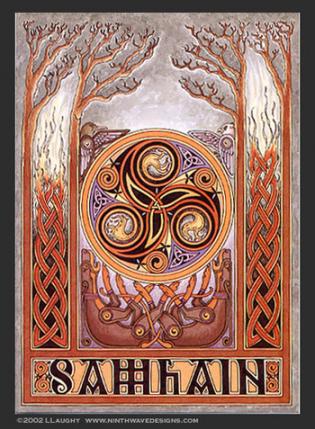
Samhain

This is considered the most important sabbat because it is a time to honor and respect those who have passed on, from ancestors to friends to pets and beyond. Sometimes the spirits of the departed are invited to join in the ritual. It is also the festival of darkness to be the balance of the opposite point in the wheel, Beltane, which is the festival of light and fertility. Samhain typically begins at sundown on October 31. This is the point at which the veil between the earthly life and the afterlife is the thinnest. Most people celebrate Samhain without even realizing it in the form of Halloween.

Yule

This sabbat eventually became Christmas to the secular world. Yule is the point of the winter solstice and celebrates the hope for a fertile and peaceful season. It also celebrates the rebirth of the great horned hunter god, who is the newborn solstice sun. He is the male to the female, the balance again, just as the winter solstice is the balance to the spring solstice. It is a celebration of the ending of the dark half of the year and the return of the light half of the year. Most Yule traditions have been adapted into Christmas traditions since the rise of Christianity.

Imbolc

This is the time for dedication once again and pledges for the coming year. It is the rebirth, the new spark of life, the ending of the darkness and the beginning of light – the beginning of spring. Brigid is honored at this time as the triple goddess. She comes from Celtic tradition but the Catholics created St. Brigid’s Day to coincide with Imbolc. This is a traditional time for initiations and it is generally seen as a womens festival. Lambs are also symbolic during this season. Brigid is a goddess often celebrated by poets and those with creative energies. She strikes me as a jack of all trades, a goddess who can do anything, etc. I like her.

Eostra

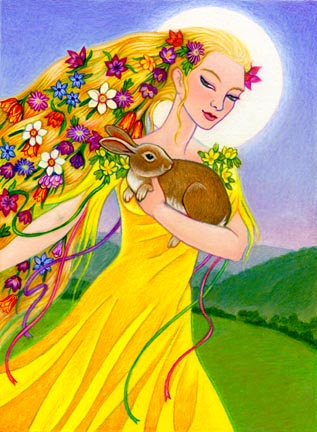
Otherwise known as Ostara, it is the spring equinox. Traditionally, it is the celebration of the Mother Goddess being reunited with her son, who spent the winter season in death. Other variations of this sabbat include the young God regaining strength in his youth after being born at Yule, and the Goddess returning to her Maiden aspect. The Goddess has three forms – the maiden, the mother, and the crone – all celebrated symbolically with the passage of the seasons. Eostre is the goddess associated with this sabbat and she is the reason why Christianity has Easter. She is connected to fertility and renewal. Eggs and rabbits are sacred to her. Sound familiar?

Beltane

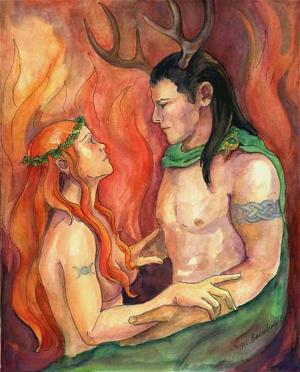
Again, this sabbat focuses on fertility like Eostra and it also employs the use of a bonfire. Sometimes there is a ritual of maypole dancing. There may also be an enacting of the union of the May Lord and the May Lady. It is a celebration of love, sexuality (although no sexual rituals are observed!), fire, fertility, male, female, union, and so forth. May morning is a magickal time for wild water (dew, flowing streams, and springs) which is collected and used to bathe in for beauty, or to drink for health. Beltane marks the return of vitality, of passion. Ancient Pagan traditions say that Beltane marks the emergence of the young God into manhood. Stirred by the energies at work in nature, he desires the Goddess. They fall in love, lie among the grasses and blossoms, and unite. The Goddess becomes pregnant of the God. To celebrate, a wedding feast, for the God and Goddess must be prepared.

Midsummer 

This is the height of summer and the days are at their longest. It is the summer solstice, balancing the shortest days of the year at the winter solstice, or Yule. It can also be called Litha. Midsummer became the nativity of John the Baptist in Christian tradition. Midsummer Eve is the evening of herbs. The herbs and flowers gathered this night are considered exceptionally potent. It is at Midsummer that the Holly King, God of the Waning Year, has encountered the Oak King and succeeded in usurping the reign of the year. In Celtic Mythology the Young God withdraws into the Wheel of the Stars and it is here he waits and learn before his rebirth at Winter Solstice. It is the time when Belenus, Belenos – the Sun god, begins to die, fir-branches; Balefires; were kindled to light his downward path, he will return again at the Winter Solstice, when the Yule logs and lit fir-braches will guide His return. A few of other deities associated with Midsummer include: Lugh, Lleu, Lugos, Aine.

Lammas


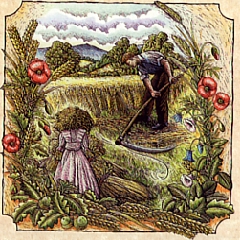
This is the beginning of the three autumn harvest festivals, the other two being Mabon and Samhain. It is a celebration of the first wheat and grain harvest. Some people incorporate the tradition of baking the figure of a god into bread and symbolically sacrificing and eating it into celebrating this sabbat. This is a celebration of a feast of thanksgiving for the first fruits of the harvest, being grain and bread. The feasts reflect this celebration. In Christianity, the first wheat harvest was used to bake a loaf of bread for the church. Lammas also represents the culmination of the marriage between the Goddess and the God that took place on Beltane. The God now becomes the product of that blessed union – the bountiful fruits and grains – and must be sacrificed. He is the personification of the crops that must be harvested for the survival of the people.

Mabon


This is the fall equinox and the second harvest sabbat in the Wiccan calendar. The equinox means the day and night are equal in time. It is a ritual of thanksgiving for the fruits of the earth and a recognition of the need to share them to secure the blessings of the Goddess and the God during the winter months. We all take a moment to pay our respects to the impending dark. We also give thanks to the waning sunlight as we store our harvest of this year’s crops. Offerings of ciders, wines, herbs and fertilizer are appropriate at this time. Wiccans celebrate the aging Goddess as she passes from Mother to Crone, and her consort the God as he prepares for death and re-birth.

Read More

>Burning myself, the ex-Catholic witch

Posted by Jessica Jewett 6 Comments »

>

I have always struggled to define my spiritual position in a world where people try to force each other into neat and tidy categories. My childhood was filled with Sundays at church, getting kicked out of Sunday school for asking too many questions, hiding my intuitive nature from the church, etc. I touched on Wicca practices in high school but getting ridiculed here in the deep South the one day I wore a pentacle necklace made me reject that path and return to being a good little Christian like every other kid in the school. I became a purist and promised, for a time, to save sex for marriage and ignore my intuitive nature because those were things taught in the church. Anything that felt good or different from church teachings was condemned and a source of immense guilt for the offender. That’s the thing about Christianity. It has taken two thousand years to make guilt into the greatest work of art in history.

To make a very long, winding story short, becoming so much more comfortable in my own skin and my own spirituality in the last few years has led me to a crossroads in which I have chosen to embrace the Old Religion. I no longer consider myself part of the Christian population. That took a lot of soul searching and exploration because I still live in a part of the country where there are churches on every corner and being different is not exactly accepted. Added to that, I’m also working on leaning into becoming a vegetarian. I think my family is having a harder time with me rejecting meat than rejecting Christianity! I haven’t even told my grandmother about this yet because I don’t think she would understand. She tells me to pray all the time and badgers me to go to church with her. She is getting rather old and I don’t want the last years of her life to be marked by disappointment in me leaving the church.

Coming to this decision certainly wasn’t easy and I struggled for a long time. The Old Religion always felt more natural and fit with my natural beliefs but the issue of guilt had a stronghold on me. It still does in some ways. I went to an outreach meeting with my friend by the House of RavenStone to see what the people in a coven might be like and about halfway through the meeting, I reached an epiphany. I have been a hypocrite for a long time. I have been attending churches my whole life that, by definition, view my intuitive nature as something evil and my willingness to use that nature as consorting with the devil. I shouldn’t have to hide who I am when I’m at church as if I’m ashamed of it when, in fact, I’m not ashamed of it and I don’t believe it’s evil.

Then it all became very simple and clear:

Christianity has been making me feel guilty for so many years because I’m not living up to that deity’s expectations as dictated by the church. God is in control. God wants this for you. God wants that for you. It doesn’t matter what you want. Just repress yourself and serve Him because you were born full to the brim with sin and you have to work off all those demerits to get into Heaven. Believing in reincarnation, psychic power, and so forth, is an automatic one-way ticket to Hell with murderers and child molesters. Really?

The Old Religion is different. You are not subservient to the higher powers – you commune with them because divinity is in everything, including yourself. The universal energy is neutral. Your choices through life determine whether you turn your energy into positive or negative. You are in charge of your destiny with the guidance of the god and goddess. The energy you put out in the universe through your thoughts, actions and intentions return to you threefold. Beliefs are not dictated to you but learned and cultivated through study and experience. You are not even forbidden from representing your creative life force in the form of the Christian god, the Virgin Mary as a goddess, and so forth. The path of spirituality is your own with a few universal principles and practices. These are basic principles that I have been teaching people for years without really knowing that they were technically defined as Wiccan principles.

So, the epiphany came. I can no longer call myself a Christian when my beliefs and practices have always naturally taken the path of the Old Religion. There I am free to be myself without having to feel guilty about my ability to read energy from the living and those in spirit. Self-expression is allowed. Representing and recognizing the creative life force in anything around you is allowed. There is no cause for guilt as long as you’re not harming yourself, other people, animals, plants, energy or spirits.

Does this mean I’m rejecting God? No. It means I find the Christian deity too limiting and I always have. My faith in the creative life force (what you might call God) is stronger than ever. I just can’t put myself into that tiny little box of Christian indoctrination anymore. I feel like I’ve emerged from being brainwashed and lived to tell about it. That might sound harsh but it’s how I feel. While I’m still struggling to let go of the oppression of guilt, I do feel like I’ve come into my own and I’m being much more honest about who I am. Of course, I run the risk of seriously offending the more conservative people among my friends and family, and believe me when I say I’ve agonized over that. I just cannot keep going like this, knowing what I am inside but denying it out of guilt.

An ye harm none, do what ye will. – That includes me. It’s time for me to stop harming myself by trying to be what people expect. This is me. I am no longer a Christian. I am on the path of the Old Religion and becoming a witch. It is not devil worship, nor is it going around in pointy black hats and riding brooms. It’s older than Christianity. Accept me as I am and I will accept you as you are. It begins with accepting myself.

Read More

Categories