

>Southern Belle: romanticism or revisionism?

Posted by Jessica Jewett 1 Comment »

>

Students at the 1861 Athenaeum Girls’ School.

Last night I watched a documentary on PBS called Southern Belle that depicts girls between the ages of 14 and 18 attending a sort of reenacted girls’ school in Columbia, Tennessee, in the year 1861. There is a waiting list several years long to the point of a 6 month old baby already being scheduled for a future class when she becomes a teenager. Additionally, every April, there is a condensed weekend version for ladies over the age of 19.

A short history of the actual school written on their website:

The Columbia Athenaeum School for Young Ladies was founded by the Smiths in 1852 and for over fifty years it enjoyed a national reputation for its quality and breadth of curriculum, which offered courses in mathematics, science, and business…studies which were normally reserved only for young men. The school offered students well-equipped departments in art, music, history, science, and later on, a complete business and commercial department. The library contained over 16,000 volumes and the department of natural science held over 6,000 specimens, some of which remain and are on display.

It was actually a very progressive school for the mid-nineteenth century because it was thought at that time that ladies could not learn on the same level as men. This school was experimental and cutting edge in the way it showed Tennessee and the South that they were wrong about the strength of the female mind.

Today, the school is reenacted every summer for a week in July. In fact, the class of 2011 is in session right now. The week is described on their website in this manner:

Today, The Athenaeum Rectory is owned by The Association for the Preservation of Tennessee Antiquities and is maintained and operated by the Maury County Chapter of the APTA as a historic house museum. In an effort to continue the outstanding heritage of the original school, two important education events are still offered.

The 1861 Athenaeum Girls’ School will be conducted during the week of July 9 Young ladies leave St. John’s Episcopal Church after morning services through 15 in 2011. Young ladies age 14-18 come from all over the country, dressed in authentic 19th century costumes, and study the same courses in etiquette, penmanship, art, music, dance, and the social graces. In addition, they participate in side-saddle horsemanship, archery and other sports. The week is highlighted on Friday evening with graduation ceremonies followed by the formal ball to which they are escorted by members of the Jackson Cadets, a local group of young men dedicated to the study of mid-19th century history and customs.

On April 29 – April 30, 2011, a condensed version of the school is offered to women of ages 19 and above. Also attired in 19th century costume, for two days the ladies participate in the same kinds of activities taught by the same qualified faculty as do the young women.

Basically, a prestigious girls’ school at the highest level of education has been turned into an 1860s summer camp and PBS aired a documentary about it. Cameras followed these teenage girls as they went through their daily classes and activities, many of them having arrived with stars in their eyes about how they, “love to dress in costumes,” and, “always loved watching Gone with the Wind.” I cringed at first. If you are the slightest bit educated in mid-nineteenth century history, you know that Scarlett O’Hara is not an accurate representation of the average Southern woman. I felt a little better when the instructors repeated that Scarlett O’Hara is not to be emulated, but I noticed that even though they said that, they still taught the girls a lot of Scarlett qualities that really amount to an idealized version of the Southern lady not necessarily rooted in reality. Some of the things the girls were taught clearly came from etiquette books of the period but fail to match the women who left behind dairies of their real lives.

Immediately, I noticed a mixed bag of mid-nineteenth century attire on the girls. Some looked like they stepped right out of 1861, while others looked like they were wearing cheap Halloween costumes. The matter of attire might seem trivial but we are putting it in the context of giving the girls an “authentic” experience of living in July 1861. A woman in that time used clothing as a way to express herself. While she was severely restricted under seven layers of underclothes and hoops, she could make statements with her dresses and the way she trimmed them (supposing she had the money to do so). Clothing is a vital part of understanding the 1860s woman and I felt there wasn’t enough proper instruction in that area. In fact, I saw no instruction. There was a clip of two girls trying to figure out how to get dressed and one of the girls wore a corset without a chemise. A chemise was necessary in that time because corsets were not easily washed and a chemise protected the corset from sweat and dirt from the body. By not teaching the girls why things were done that way, they’re not offering a real “authentic attire” experience. Curious, I looked at the requirements on their website and they are very lax on what the girls should wear. They give a list but no explanation of why these items were used. The teachers were not accurately dressed either.

Another aspect of life in 1861 for these girls in Tennessee that went completely ignored was slavery. One of the teachers was asked why he doesn’t teach them about interaction with slaves and race relations and his response was, “We just don’t.” He couldn’t give a reason. You cannot possibly understand being a privileged girl in Tennessee without understanding slavery. They’re totally ignoring the race question at this school, which, in 21st century standards, is expected and necessary, but in 1861, it was in their faces every day. They’re also teaching these girls that slavery had nothing to do with the war. I have no desire to get into a debate about what started the war but my northern upbringing chafes at those statements. These historians articulate the other side of the issue better than I could.

My issue is I can’t tell if this guy is channeling 1861 or speaking as a modern man looking back on 1861. Another historian made that point too. What you don’t see in that clip is the teacher discussing how his great-grandmother was still around when he was a child and her father was a Confederate prisoner of war. He was not allowed to even bring money into her house with Lincoln’s face on it and admitted somewhat hesitantly being raised in a certain mentality. He is three generations removed from the war and still brought up in a certain way that he whitewashes when he teaches the girls every summer. I have certain scruples about that.

My biggest scruple with this girls’ school is that they’re completely ignoring the academic education that the real girls in the nineteenth century received. To me, it sort of undermines the memory of those girls and how hard they had to work for their education. Remember, those girls were not supposed to be educated and men were turned off by such women. They were going against the grain. They were pioneers. The girls attending the school in the summer now should have more exposure to the academic education their foremothers received in order to really see what they endured and how hard they worked to better themselves. They should be taught more than the idealistic image of a Southern woman. Real Southern women have a long history of being stronger than people expected, resourceful, loving, tough, ladylike, yet still highly clever and intelligent. Yes, there were rules in society and they strove to reach the perfect image of a Victorian woman but they also had their feet firmly planted on the ground and did whatever was necessary to survive. The docile, sweet, perfectly submissive Melanie Hamilton idea of Southern women seems as inaccurate to me as the overly opinionated, vivacious, conniving Scarlett O’Hara idea of Southern women. I don’t think you can categorize Southern women at all. They were and are all individuals.

Sweeping aside my criticisms of how the 1861 Athenaeum Girls’ School is operated today, I do see some positive things. I do think girls at that age in their teenage years should be taught things that are becoming lost in the development of technology and changing gender roles. I do agree that womens’ rights do not have to mean a woman no longer should be feminine if that’s what she wants for herself. To me, womens’ rights gave women the choice to be whatever their hearts desire, even if that is an old-fashioned housewife. The girls at this school are taught manners, etiquette, art of conversation, how to write letters, etc. All of these things, while being taught in 1861 context, are still very applicable in the 21st century context. I also think this is a good way for like-minded girls to meet each other and become friends since they would certainly not have met in other circumstances.

I will readily admit that I was not born and raised in the South, so I’m not likely to really understand the Lost Cause mentality that certain places like this school embrace. It’s all about perspective. If I was raised amongst those ideas, I would probably be lying about my age and bribing people to let me into that school. Things being as they are though, I’m not entirely sure that I would send my daughter there even if it is just a summer camp. I think I would actually have to go there and see it for myself. Southern girls who love history and their heritage will certainly jump at the chance to attend this summer camp.

The thought did cross my mind, though, how fun it would be to run a similar summer camp from the northern perspective. There should be an alternative for the other side.

Read More


Arthrogryposis Awareness Day is Thursday!

Posted by Jessica Jewett 12 Comments »

>Every person in the world carries a burden that makes them extraordinary.

This is not about attention. This is about raising awareness.

Thursday is Arthrogryposis Awareness Day, a day that was begun by AMCsupport.org – a nonprofit organization designed to educate, raise funding for families of children with Arthrogryposis, and draw attention to a condition that has not yet been researched enough by the medical community to find a cure. People are being encouraged to WEAR BLUE THURSDAY to show their support for raising awareness for this condition and also to educate themselves. I’m doing my part today by teaching you about my disability.

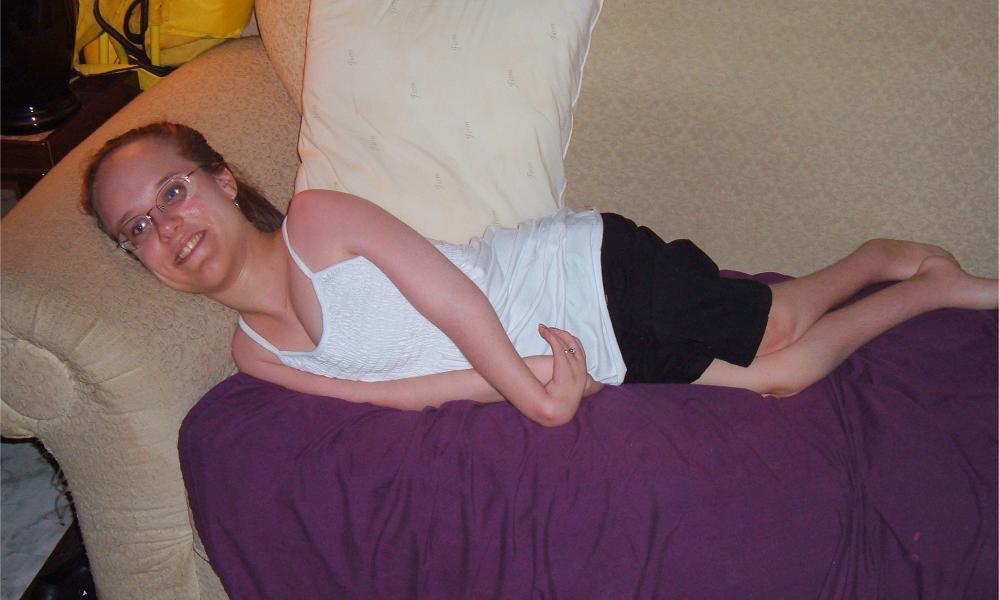
I had intended to find pictures of Arthrogryposis for examples but searching Google Images showed me sights of fetuses and babies with the condition who did not survive. I couldn’t take that sight. Instead, I’m showing you a couple of pictures of me in which you can see my deformities. This was not easy for me to do because I typically hide it in photography but people need to see what it really looks like. Here it is.

The full, obnoxious medical name of this condition is Arthrogryposis Multiplex Congenita or AMC for short. Let’s break that down. Arthrogryposis means hooked or curved joints, in so many words; and Multiplex means the condition is found in multiple limbs; and Congenita means from birth, as in this is a condition that is present in children beginning during gestation. In other words, this is a condition of curved or hooked (deformed) joints in multiple parts of the body from birth. That’s the most simple explanation I can give but this condition is so complicated and difficult understand let alone diagnose that most general practitioners have never seen it. I know this because I have only had one general practitioner in my entire life (my present doctor) who didn’t have to Google the word Arthrogryposis as soon as I gave him my patient history. Usually doctors will smile and nod when I tell them what my diagnosis is and that they quietly excuse themselves to go and get on Google like everybody else does. When a doctor has to do that, you know it’s not a very common condition. I actually had a hospital in Texas refuse to admit me to the ER once because they didn’t recognize my disability and they didn’t want to be liable if they treated me wrong.

Basically, what has happens to a person with Arthrogryposis is that during their gestational period, while their joints were forming, something went wrong and their joints became overgrown with fibrous tissue to the point of severely restricting mobility and causing deformities. If the fetus cannot move adequately, muscle tissue does not develop properly, nerve tissue does not develop properly, bones do not develop properly, and so on and so forth. The lack of mobility in joints affects so much more than just the ability to move. Added to the overgrowth of fibrous tissue on joints, the fetus cannot properly bend over in the womb (the fetal position) and that causes scoliosis – a severe curvature of the spine – as well as deformed hip joints and deformed arms and legs.

When I was born, my legs were crossed as if sitting Indian style on the floor. Go sit on the floor Indian style and look at your legs right now. That’s how my legs were permanently positioned in the womb and I could not turn around to come out head first, so I tried to come out knees first. Naturally, my mother had a cesarean section because of the severity of my disability. As soon as I was born, I was taken away to a completely separate hospital equipped to deal with special needs babies and my mother didn’t see me for several days. They didn’t know what to do with me so they put me in with the preemie babies and the nurses started calling me a monster because I was so much bigger than the other babies for whom they cared. Doctors from all over the city came to examine me because they had never seen such a severe case of Arthrogryposis. An immediate study of my genealogy was done to see if anyone else in my bloodlines had the condition but the study was incomplete due to huge gaps in my family history. Pictures were taken of me to put in medical textbooks and my mother had to go and speak to a gallery of doctors about the conditions of her pregnancy, our family history, and so on and so forth.

Arthrogryposis is found in approximately one in 3000 live births in this country. It covers about 400 different clusters of symptoms, meaning there are several symptoms associated with it but they can be found in about 400 different combinations. It can range from anywhere between just having deformed hands all the way up to complete quadriplegia with lockjaw and developmental disabilities. The symptoms associated with Arthrogryposis can include but are not limited to hip/shoulder dysplasia (this is when your hip/shoulder joint does not form properly and you are not making the ball and socket connection because either the ball or the socket are not there or so severely deformed that they can’t form a hip/shoulder joint), scoliosis, arthritis, osteoporosis, clubfeet, severely shortened tendons and ligaments (this is a main cause of deformed hands, knees and feet when the shortened connective tissue pulls those limbs downward), depressed lung function, heart disease, and a myriad of other symptoms.

Roughly 30% of children born with Arthrogryposis do not live to see adulthood.

There is no curative treatment for this condition, although parameters have been defined in the last 20 years or so by doctors who actually have an interest in making life more bearable for their patients. I was born about 10 years before these parameters were defined enough to make a difference, so I was more of a guinea pig for my doctors than anything else. I spent the first couple of years of my life in Denver, Colorado, and there was a time when I had to fly once a month to Salt Lake City, Utah, because that was the only children’s hospital in the area equipped to deal with my disability. It is extremely important to treat Arthrogryposis as best as doctors can before the child reaches puberty because the body has not finished developing and it’s easier to loosen up all the tight limbs. I had most of my surgeries before age 12 – by “most” I mean I’ve had somewhere between 17 and 20 surgeries (I lost count) in my 29-year lifetime. It’s not uncommon at all for someone born with this condition. They have to treat each limb at a time. First I had surgery to cut the tendon in my neck because it was too short and I could not pull my head up straight as an infant, then I had clubfoot surgery, then I had surgery to break my thighs and turn my legs into a correct position for sitting rather than the Indian style position, then I have hardware put in my hips to try and stabilize my joints, then the hardware was taken out because it was painful and making me bleed, and then I had my entire spine fused with titanium rods from neck to tailbone, and so on and so forth. Doctors have tried to get me to have surgery on my hands over the years to straighten them out (think of Capt. Hook) but it’s not going to do any good. It would only be for cosmetic reasons and I’m not interested in trying to look “normal” if I’m not going to gain any function out of it. I’m still looking at more surgery on my feet and I’ll be 30 next year. It never ends.

Most children born these days with Arthrogryposis have a good chance to at least have enough successful medical treatment to use a walker or crutches instead of being completely dependent on a wheelchair like I am. My time has passed. My body is finished developing and the treatments that they are using for children now are not going to be as successful for me so I will remain completely dependent on wheelchairs. I will never walk. I will never stand on my own. I consider myself blessed, however, because I do have full and complete sensation in my body, meaning I can feel everything done to me – both pain and pleasure. There seems to be a misconception that all quadriplegics can’t feel anything, which is completely not true. I do not have a spinal cord injury. That is what determines whether you physically feel things or not.

The human body has an amazing ability to adapt. I have seen many people with Arthrogryposis teach themselves to be independent at very young ages by using their feet or their mouths in place of their hands when the hands are too deformed to function. People seem to think it’s strange or unheard of that I do everything with my mouth – drawing, typing, writing, and everything else – but it’s quite common amongst those with Arthrogryposis. We were never taught to adapt that way. It happened by instinct out of necessity when we were babies or toddlers. I was once even told about an artist colony in Italy specifically set up for artists who use their mouths or free instead of their hands. We are out there. We are products of nature’s wonderful ability to adapt for survival.

Life can be expensive for us though and without Medicaid, we would all suffer a great deal. Power wheelchairs start at $15,000. I had one that was $35,000 once. Adaptive equipment like braces, eating utensils, writing utensils, lap trays, ramps, shower chair, toilet chairs, and so on, run into hundreds of thousands of dollars. I remember seeing a bill for my shower chair once and it was $4,000. Most things are provided to us by Medicaid but transportation is another issue. People are always stunned to find out that I don’t have a wheelchair van and I cram my wheelchair into a Dodge Neon. First you have to buy the van. Then you have to take it to a specialized shop and drop about $50,000-$100,000 on lowering the floor, installing special shocks, special tires, and either the ramp that pulls out from the floor to the street or the hydraulic wheelchair lift. That’s why I don’t have a van. Additionally, a person with Arthrogryposis can run up medical bills running in the millions of dollars over their lifetime if they go through as many surgeries as I have.

For children born with Arthrogryposis, the chronology of our lives were marked by which surgery was happening when and which hospitals we were calling home at any given time. A lot of people like to say to us, “You are so special. I don’t know how you live the way you do.” I noticed that most of us as we reached adulthood had a difficult time accepting praise of that nature without feeling like it was undeserved because we simply don’t see ourselves in those terms. We just don’t know any better, the same as people who were born with the ability to walk don’t know any better. I can’t even wrap my brain around what the ability to walk would be like any more than anyone else could wrap their brains around what it would be like to be restrained to a wheelchair day in and day out. It’s all a matter of perspective. What is normal to one person is terrifying to another person. I’m well-aware that my life might not be as long as other people. I have been warned since childhood that chances of heart disease are much higher for me than others because I have Arthrogryposis and I have to start watching my heart better at 30. I’m 29 now. My kidneys struggle as well, which is something else they tell me can get out of control if I’m not careful. Regardless if I die tomorrow or when I’m 100, nobody else knows how long they will live and I’m not worried about it. I’m already doing better than the 30% of children with Arthrogryposis who do not live to see adulthood.

I have been told that I shouldn’t do Civil War reenacting, or I travel so much, because I have Arthrogryposis. Even a man I casually know once said, “Did you really come here by yourself?” and when I said yes, he said, “Wow, that’s crazy….” as if he couldn’t believe I could go anywhere by myself. (Hi Jon. I’m calling you out. Love you.) People who say those things catch me off guard even when it’s lighthearted joking because I don’t think in those terms at all. What’s crazy to me is shutting myself up in my house and living life from my bed and my laptop like an invalid. People who see me doing something totally normal in my world like signing my name with a pen in my mouth and then becoming utterly astounded by it confuse me sometimes too. What I mean to say is I don’t see myself as disabled or amazing until someone points it out to me and then I’m sort of taken aback, like, “Oh yeah…. There is a disability in me and not every quadriplegic has the gumption to go whitewater rafting, horseback riding, swimming, traveling, etc., etc., like I do.” I was not raised like a disabled girl. I was raised like a girl who needs to find different ways to live because life is short and cannot be wasted on self-pity or fear of leaving the house. I have seen disabled children raised completely coddled and overprotected by their parents because it’s a parental instinct to care for a helpless child but my parents let me find my own way in life. I have pictures of camping with my father as a toddler. I have other pictures of bass fishing with my mother. If I want to do something, I think about it until I come up with a way to make it happen. If I ever have children, they will be raised that way too.

My only wish is that more children don’t have to be born with Arthrogryposis. I’ve had a good life but I’ve had a very hard life too and I’ve wanted to give up many times. I can’t imagine there will ever be a cure but we won’t ever know unless we try. A few doctors in New York and California are known to study it but I’m not aware of any other serious research. The problem is that American society is obsessed with celebrity and without a celebrity face saying, “I have Arthrogryposis,” there won’t be that push to research, improve treatments, and one day maybe find a cure. My blog only throws a pebble into the water but it’s something. If enough people throw enough pebbles into the water, a real difference could be made. Even if we never find a cure to prevent it from happening to other children, more education needs to happen in order for more effective surgeries, therapies, and so forth. The goal needs to be giving children the most mobility and protection from pain as possible. One thing doctors didn’t prepare me for – maybe because they didn’t know – is the rapid aging my body has gone through since I was 25 and how much pain I live with as I age. I’m only 29 but my body has osteoarthritis, anemia, chronic vertigo, etc., as if I am approaching my elderly years. This may not be common for less severe cases of Arthrogryposis but I’m shocked at how fast I feel like I’m aging. I feel like younger generations with this condition need to be better prepared for the long haul.

How can you help? Donate your time and resources to children’s hospitals. The majority of our childhoods were spent in those places. Also, make donations to Arthrogryposis Multiplex Congenita Support, Inc., at www.amcsupport.org and help take care of families with Arthrogryposis children in need of medical equipment and medical treatments. Encourage and support people of all disabilities. Above all, educate yourselves and encourage the medical professionals to educate themselves about Arthrogryposis as well.

And WEAR BLUE ON THURSDAY. Show your support!

Thank you.

Read More

The Charge At Fort Hell: A wife’s point of view

Posted by Jessica Jewett No Comments »
Fanny Chamberlain in the Civil War.

In my last blog, I posted Joshua Lawrence Chamberlain’s account of how he was shot and almost died while leading his men on foot outside of Petersburg, Virginia. It’s important that you read his own words about what he endured before you read my own words about what I endured. I was his wife in my previous life at that time. That’s me in the picture on the left. I’m not here today to provide proof of reincarnation or who I was back then, so you might as well skip this blog if you’re just here looking for credibility or to discredit me. Frankly, I don’t care who believes and who doesn’t believe. It doesn’t change the truth. Some things are true whether you believe in them or not. I’m here to talk about that terrible summer in 1864 and what I went through and how it still affects me today.

It took most of my present life to get into a peaceful place where I could actually talk about the things I witnessed back then. I started having nightmares and flashbacks about it when I was a small child before I even knew who these people were, where these places were, or even being in a developed position to understand wars, combat and bloody wounds. There were several times as a little girl in which I woke up sobbing and terrified but I didn’t have the words at that young age to explain what I was seeing in my nightmares. I was also ashamed and couldn’t talk about it even after I figured out I was having Civil War nightmares. I talk about all of this in greater detail in my book, Unveiled: Fanny Chamberlain Reincarnated.

The initial nightmare was of being inside an army tent and watching as a handful of men performed a horrifyingly painful procedure on a man lying on a cot. When we remember things we saw as children, everything seems a lot more exaggerated than it really was, and I remember my initial nightmares being ridiculously bloody and the men being sadistic and torturous. The reality was one of them was a doctor and they were probably putting a metal catheter in him (Lawrence), which was supposed to allow his bladder to empty while the wounds were healing, but I still don’t know exactly what I saw because I couldn’t see everything.

19th c. diagram of inserting a catheter.

Catheterizing people was new and experimental in the Civil War. Lawrence’s wound trajectory passed through his pelvis in such a way that the bullet damaged his bladder and urethra, so not only was he bleeding from the entrance wound at his hip but urine was leaking from his bladder through the entrance wound as well. When he was transported to Annapolis for medical care, Dr. Vanderkieft was the head surgeon there who basically thought – well, he’s going to die anyway, so why not experiment with this new catheter system. There was no such thing as plastic in the Civil War, which meant that the catheter was metal, and inserted through the penis to the bladder. Deposits from chemicals in the urine attached to the catheter and eventually blocked the flow after three or four days and the painful process of pulling out old catheters and inserting new catheters for weeks and weeks on end created a fistula. A fistula is a hole in tissue, usually near genitalia, that does not heal and causes incontinence, infection and so forth. He went through a few surgeries long after the war to try and close the fistula but the damage was done. I’m certain the catheter experiments did more damage to his body than the actual gunshot did. He was no longer able to father children, he suffered from periodic incontinence, almost constant pain, various infections, illnesses, swelling, etc., for the next fifty years until his death of urisepsis. Certainly Lawrence would have suffered because of his wounds regardless of how they healed but the areas that Dr. Vanderkieft didn’t mess with much healed naturally and were much less of a problem in his elderly years than the areas on which were experimented.

See what I did? I got uncomfortable with talking about it in personal terms and jumped right into historical facts about the situation rather than get into my feelings. It’s a coping mechanism. I think I get so into historical research as a direct result of my trauma – because I’m somehow trying to understand why it happened at all. It has been easier my entire life to approach it as a historian and spit out cold facts at people rather than risk exposing my own wounds. These things don’t just go away when we die. Trauma takes multiple lifetimes to heal and there were only 77 years between my death as Fanny and my rebirth as Jessica. In spiritual terms, that’s a blink of an eye. It’s all still quite fresh and raw to me even though I have made great strides in making peace with what happened. I was not shot in combat but he was such the love of my life that witnessing his suffering was like going through it myself. Not only did I care for him for months in the hospital but I saw other men cut to pieces, dying, suffering and enduring their own wounds. I cared for some of them too. I was also pregnant at the time.

Of course I don’t recall everything about the summer of 1864. Nobody can remember everything about past lives. People who claim to know everything about their past lives are likely embellishing or not telling the truth at all because past life memories are typically spontaneous, uncontrollable, brief and sporadic. In my case, I had flashbacks to the Annapolis hospital very early in my life because trauma carries with you stronger than any other emotion. There are just a few scattered memories that repeat themselves periodically in my life like a loop of film going around over and over again. I got a decent grip on it in my early 20s though because it was giving me such anxiety that it was affecting my ability to function in my everyday life. Past life flashbacks can be extremely vivid and stick with you for months or years. If you don’t get control over it, learn what you’re supposed to learn from it, cope with it, and let go of the negativity associated with it, you will get stuck in the past and fail at your present life. I have seen people get so stuck because they can’t control it that they fall into serious depression and some have become suicidal. I know one woman who attempted suicide three times because she couldn’t release the trauma of her last life. Luckily, she found a therapist who understands past life trauma and she is much better now.

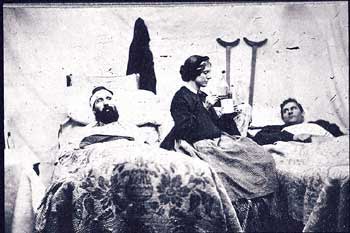
Woman taking care of wounded Civil War soldiers.

The reason why this war and my husband getting shot was so traumatic for me was because I was told he was going to die from the moment news got to me. I was just beginning to realize that I was pregnant when it happened and I had two other small children at home. When a woman is told her husband is going to die, there is almost no time for shock or grief. As a mother, I had to frame my mind around this loss and figure out what to do with my life to provide for these children. Lawrence was shot on June 18 and I left Maine for Annapolis by about June 20. Time was off the essence. I was trying to reach him before he died so I could say goodbye to my husband. Instead of him dying within days, we were jerked back and forth between hope and despair for weeks and he went through delirious fevers, agonizing pain, medical experiments, and knowing that he should have been dead. The psychological damage when you watch someone you love suffer like that for weeks upon weeks, waiting at any moment for death to come but never does, is almost impossible for me to describe. I spent three months when I was writing my book trying to describe those feelings but I realized people simply cannot understand if they haven’t been through it.

There are a smattering of flashes, images, emotions, sounds and even smells from that time throughout my life which I have tried to articulate with words before but it never comes out right. Sometimes there were flashes of looking down on the body of a bearded, dirty, feverish man and I used to think they were images of a dead man until I understood it was Lawrence in the worst moments after the gunshot when I first got to him. I used to wonder why he was so dirty until I studied the war better and realized that cleanliness was not the priority when someone was sick or wounded. The hospitals were always short staffed. It would have been up to me to clean him up and make him more comfortable, which I did most certainly. Another time, I have a vague recollection of him being more lucid. It felt like nighttime and I was leaning over him talking quite seriously but what I said escapes me now. He pressed his hand to my cheek and said quietly, “You shall have to be their mother and their father.” It was like being punched in the stomach and having the rug yanked out from under my feet all at the same time. There was a brief time when we both truly thought he was going to die.

He survived by the grace of the divine and was home in time for the baby to be born. She was our last child and I thought he was home for good but he left not long after her birth to rejoin the army. Five months after he was shot and came as close to death as I’ve ever seen anyone get, he couldn’t even mount a horse but he was eager to see the end of the war. I was not very happy with the decision. He developed post-traumatic stress disorder (although the condition was unknown back then) and we struggled for years to hold our marriage together. As much as I study the war now and feel pride for his service to his country, I have a lot of resentment toward the war also. That war and every war before and since then destroys the greatest men of their generations one way or another.

Read More

Categories