

The Lady Civil War Reenactor: Part III

Posted by Jessica Jewett 1 Comment »

Reviews of Part I and Part II

In the first part of The Lady Civil War Reenactor, I gave an introduction about what should be expected at most reenactments for women, why people choose to participate in reenactments, and a list of vocabulary commonly spoken by people in the reenactment community.  In the second part of The Lady Civil War Reenactor, I talk about building the impression (persona) that you’ll use at reenactments and what should be avoided. I also put up a short questionnaire designed to help you build your impression.

Today we’re going to get into more of the specifics in each type of impression for female Civil War reenactors.  It’s so vast, however, that I will break it down into the basic economical and social groups and the differences between Union and Confederate women within those economic groups.  Keep in mind that research is never going to stop.  I’ve been doing this on and off for going on two decades now and I still do research in primary sources like photographs, letters and diaries.  There is no such thing as, “I know everything about Civil War reenacting.”

Types of Ladies Impressions By Economic and Social Status

Lowest Class

The lowest classes of women on both sides of the Mason-Dixon were known as “public women”.  The ideal image of a woman in the 1860s was a modest, virginal, angelic type.  Much of Victorian society was based on rules of chivalry from the Arthurian period of history.  A woman who dared to live her life in the open was considered immodest and immoral.  A “public woman” was a prostitute, an actress, and any other woman who held a job that was not considered feminine.  Contrary to popular belief, the nursing profession was, until the Civil War, dominated by men only because it was considered indelicate for women to witness such things.  Women only entered nursing out of lack of manpower during the war and they slowly turned it into a legitimate career choice for the unmarried woman after the Civil War.  Even if a woman was filthy rich from these professions, she was still considered low class because of the perceived immorality attached to how she made her money.  The only legitimate work open to unmarried women was teaching, sometimes secretarial (although I don’t think secretary work was very common until after the Civil War), or domestic service ranging from a seamstress or laundress all the way up to being a full-time live-in servant in a wealthier home.  Upon marriage, however, a woman was expected to give up any form of work and devote herself to raising her family with a happy and grateful heart.  Even though it was acceptable for unmarried women to have some forms of work, they were still considered lower class because if their family had any money whatsoever, they wouldn’t be forced to work at all.
During the Civil War in the Confederacy, another form of lower class people came to surface in the form of refugees.  A refugee was someone who was forced out of their homes and put into poverty by the invading Union Army taking over and fighting around their properties.  If I’m correct in remembering what I’ve read, refugees were not look down upon at all because they had nothing, that put them into the low class category.  Refugees are becoming more popular for impressions in the reenacting community because it’s easier to portray people who had virtually nothing since it costs virtually nothing to build that impression.  Slave women were the lowest of the low class people in the Confederacy with free black women only slightly above them.  Conversely, in the Union, immigrant servants were the lowest class with, again, free black women only slightly above them as well.  It’s hard for me to see any distinction between slaves, immigrant servants, prostitutes and actresses as to who was above who.  Studying it closer will probably reveal the hierarchy of the lowest classes of women in the 1860s, which should be something you do if you consider portraying any such women.

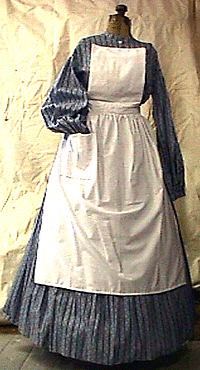
If you are doing an impression of one of these lowest class women, your wardrobe would vary depending on who you’re supposed to be.  A refugee never wears hoops and can get away with not wearing a corset.  Refugee dresses are made of rough, often homespun material, with virtually no embellishments.  There wouldn’t be a ballgown either.  Where would you carry such frivolity if you’re on the run from the Yankees?  On the other hand, a prostitutes and actresses clothing could range from looking like a refugee to looking like an overly decorated peacock because prostitutes and actresses could be dirt poor or ridiculously rich.  A ridiculously rich prostitute wouldn’t need to follow armies through the field though.  Your best bet if you’re going for a low class impression is to get a simple dress with minimal embellishment (called a camp dress), a corset and corded petticoats as opposed to full-on hoops.  We’ll get into fashion later.

Middle Class

I don’t have an exact term for it and I don’t believe “middle class” was a term used in the 1860s because we were still coming out of a time when people were either extremely rich are extremely poor without much in between.  However, I consider a middle class woman to be one that was provided for enough by her father, brother or husband that she was not working but she was not comfortably rich either.  In my opinion based on what I have read from the time, these were the most common women in America at the beginning of the Civil War.  Many of them ascended to hire positions through the war, while still many more plummeted to the lowest class during the war due to the hardships of being without their men.

Chances are, you are going to portray someone in this category.  You would not be employed.  Your father, brother or husband would basically be your lord and master no matter how old your or how intelligent your in your own right.  He would provide for you and your children.  As an unmarried woman, you would be under your father’s control.  That control would transfer to your husband upon marriage.  You would have no property rights upon marriage.  You would never serve on a jury.  You have no right to vote.  You are completely represented by the man in your life (I say brother because if you were unmarried at the time of your father’s death, your brother, if old enough, would then be responsible for you).  These average women could have any range of education depending on how their fathers chose to provide for them.  Many middle class women were very educated and could speak multiple languages because it was considered fashionable to emulate the higher classes, which were expected to be extremely educated in such things.  A middle class woman would do everything she could to appear higher socially, so she would be very inventive, she would know how to stretch her family’s dollars, she would be clever with fashion as to look higher class than she was, and so on.  In many ways, a middle class woman of the 1860s had to be more clever and inventive than her sisters in the other classes.

These women were very likely to be the ones who volunteered in various relief and aid societies that sprung up throughout the Union and Confederacy during the war.  While the higher class women would be more organizational and figureheads in such organizations, the middle class women to be the ones doing the work.  As the war went on, female nurses far exceeded male nurses who previously dominated the field.  A female nurse was required in most cases to be married and older than 25 or 30 in order to prevent indecent encounters between single women and lonely soldiers.  Many times women were only considered for nursing positions if they were only looking as to further discourage indecent behavior between the sexes.  This is something you need to consider if you are hoping to be a nurse in reenactments.  Are you married in your impression?  If not, it may not be completely accurate for you to portray a nurse.  You don’t actually have to be married in reality to portray a married woman.  All you have to do is get an 1860s appropriate ring and add marriage to your impression by saying your husband is off to war.

Middle class women were also quite often the wives of officers just based on the pay they received.  If you are portraying an officer’s wife, you would be very concerned about the men serving under him and perhaps act as a surrogate sister or mother to them.  You would make sure they had enough knitted socks, winter gloves, hats and so forth.  You would organize relief in the form of food packages, and various other things in care packages from home, much like women do today for serving soldiers.  If an officer’s wife visited in the field, part of her responsibility would be to visit with the soldiers serving under her husband and boost morale.

If you are doing a middle class impression, you would have dresses made of better materials and a bit more embellishments.  You would wear hoops more often than not, absolutely wear corsets, but you would not have the richest things.  You would have the best fakes you could afford though (fake jewelry, for example, was called paste jewelry). We’ll talk about fashion later.

Upper Class

This would be the smallest percentage of women in the 1860s, both North and South.  It is true that the North had more economical wealth spread over a larger amount of people but the South had its wealth concentrated in a very small sliver of the population – the Southern aristocracy.  During the war, these women would be wives of planters, wives of men in the Confederate government, wives of the top men in the Confederate Army, and wives of opportunists making money off the war.  The planter class – those people who lived on large plantations and generated income from slave labor – collapsed first in the war.  Once the planter class collapsed, the economic structure of the South basically collapsed along with it, leaving the top percentage of people in the extremely vulnerable position of poverty that they had never experienced.  Early in the war, your impression, if you are doing someone of the upper class, you would still portray a sense of security in your wealth.  Mid-to-late war, you would not feel so secure in it.  Late war, you probably wouldn’t have very much wealth left, although you would try to give that impression.

In the North, the wealth was not so concentrated on such a small group of people but spread out more evenly, although there were pockets of extreme while in the Northeast.  Northern families did not see economic collapse on the catastrophic scale that Southern families did, so if you are portray no woman of a wealthy Northern family, you would not necessarily feel the insecurity in that wealth like a Southern woman would.  While Southern wealth was made from mostly inherited landowning agricultural earnings, a lot of Northern wealth was made from politics, industry, business, real estate, and so forth.  Northern women had better access to European fashion, although many northeastern families were descended from puritanical culture that was not so flamboyant and flashy with their wealth.  I have seen documentation from Northern women who traveled to the South in the decade prior to the Civil War and made comments about how Southern women dressed in much brighter colors and decorated their clothes more.  So it’s important to keep in mind, when you’re developing your impression, that there are cultural differences in 1860s North America that should be entertained.

The life of a woman in the upper crust of society in the 1860s was mostly focused on managing the household, socializing, managing children, and so forth.  When the war came along, these women used their positions (because they were well-known figures in their communities) to raise money for regiments coming out of their states, they entertained officers, soldiers, politicians, and did whatever they could to boost morale.  This was much like the women in the class is below them but the wealthy women did it on much bigger scales.  Social hierarchy was extremely important to these women.  The less you had to do for yourself because of having enough servants meant that your husband was more successful than others.  Women of wealthy positions were expected to be more charitable, although the classes did not mix as much.

I suppose when outsiders think of the Civil War, they jump to Gone with the Wind right away, which would be the closest thing to the top 1% to 3% of society.  Again, do not use Gone with the Wind as a fashion guidebook.  Women of the highest class would have had the best of everything available at the time.  Remember the war created a blockade around the South, so even the most wealthy women were having to turn old dresses inside out, redo them, and be very inventive because there just weren’t any new materials coming in until after the war.  Northern women were not affected so much in that manner but much of the nation’s resources were redirected to the war effort, so they did suffer for things that they had before.

I do not recommend constantly being a high class woman prancing around with her parasol and huge hoop skirts at reenactments all the time.  Think of it this way – would you go camping today in a beautiful Chanel suit?  No.  You would put on your junkie clothes because you know you’re going to get dirty and rough it.  The same mentality should be applied to women in the 1860s.  A woman during the war would not visit and army camp wearing a Worth dress because she would ruin it out there in the wilderness (Worth was to go-to couture designer of the 19th century).  It’s a good rule of thumb, even if you are portraying a wealthy woman, to ask yourself what would you do in a given situation today – whether it’s camping in the field, cooking, cleaning, doing artistic things, chasing children, etc. – and then translate that into 1860s terms.  Chances are your answer from approaching it that way would not be to walk around dressed like Scarlet O’Hara all the time.  There is a time and a place to wear your biggest, most beautiful dress, and a time to be more practical.  Most activities in camp should be more practical.  I think it’s okay to wear the bigger dresses, only if you’re wealthy, when you’re watching a company drill or on parade because part of your responsibility would be to boost their morale.  A pretty girl always boosts the morale of any soldier.

Continue on to The Lady Civil War Reenactor: Part IV now….

Read More

The Lady Civil War Reenactor: Part II

Posted by Jessica Jewett 2 Comments »

Review of Part I

In the first part of The Lady Civil War Reenactor, I gave an introduction about what should be expected at most reenactments for women, why people choose to participate in reenactments, and a list of vocabulary commonly spoken by people in the reenactment community.  I also asked that if people had questions, to post them in the comments and I would go over them in the next blog (this one).  Here are the questions I got on the last blog.

How is currency handled at events?

It’s virtually the same as going to a fair or anything of that nature.  Sutlers usually take cash, checks or credit cards, although there are some that don’t take credit cards, but they will tell you up front.  Food vendors are the same.  Reenactor registration is sometimes done online beforehand with credit cards but is also done in person at the beginning of the event usually with cash.  The best advice for attending reenactments whether you are a spectator or a reenactor is to bring both cash and credit cards to be prepared for either.

What do you wear to bed?

If you are a reenactor, that depends on your level of authenticity.  Some reenactors will choose to wear 21st century clothes to bed.  A lot choose to stay in their 19th century impression for the duration of the reenactment, which means women would sleep in period correct nightclothes.  I will discuss that in greater detail in a future blog.

How are tents set up?

That depends on the people running the events and the people in charge of your various reenacting organizations.  They’re usually set up in rows like you would see in 1860s photographs of army camps.  Tents must be period correct, made of white canvas with wood poles, and such things can be purchased from various sutlers.  Again, I will discuss that in greater detail in a future blog about equipment and what you will need to bring with you.

Can you have a fire?

In the vast majority of cases, yes.  Reenactments are very rarely held within the boundaries of national parks, which would not allow campfires.  The majority of reenactments are held on private farms nearby or anywhere else where they can borrow the land for a weekend.  A lot of event organizers will provide firewood, although it’s not always provided.  It just depends on who is organizing it and what size of reenactment we’re talking about here.

How do you get water?

Again, it depends on who is organizing the reenactment and what size of reenactment were talking about, but water is either provided by the organizers or people by water beforehand and bring it with them.  It’s like modern-day camping.  A lot of campgrounds don’t provide water, so you just go to the nearest store and buy those milk gallon jugs of water or bottled water or whatever kind of water you choose.  Depending on your level of accuracy, you should make an effort to conceal the fact that you are bringing plastic jugs into camp.

Building Your Impression

As you may remember from the last lesson in the vocabulary section, your impression is the type of person you are portraying from the Civil War.  Building and impression is basically the same thing as building your character in a play.  The best reenactors have back stories for who they are, they speak in first person, and they can tell you everything about why they’re wearing what they’re wearing, why they’re doing what they’re doing, and how it was done in the 1860s.  Especially for civilian reenactors, this is extremely important to consider.  As civilian reenactors, we are not always seen as necessary by the military reenactors, and therefore, a lot of it seemed to work harder at what we do as far as doing it correctly.  If you’re just beginning in the reenactment hobby, the worst thing you can do is go shopping on eBay, choose a dress just because it looks pretty and throw it on for the next upcoming event.  Reenacting can be a bit of an expensive hobby, so it’s really important to do the proper research before you make any purchases whatsoever.  A lot of people who are new to it usually end up buying a lot of junk in their first year that will be discovered to be inaccurate or completely unnecessary.  My goal is to help you avoid making those common mistakes so that you don’t waste money in your first year.

If you think you’re going to look like Scarlett O’Hara at every reenactment, it’s best to just put that idea out of your head right now.  A lot of women who are new to the hobby enjoy the romance and grandeur of Gone with the Wind and use it as the Bible of what Civil War reenacting should be for them.  In reality, the wealth portrayed in Gone with the Wind was really only a portrayal of the top 1% of Southern American society in the 1860s.  Additionally, the costuming in that film, while beautiful, is really just a 1939 interpretation of the 1860s, which is ridiculously inaccurate for the time.  You would not see women dressed like Scarlett O’Hara from the 1860s and if Vivien Leigh was to go back in time in her Scarlett costume, other women would look at her like she was an alien.  I’m only mentioning Gone with the Wind because of the amount of women I see at reenactments trying to emulate that movie.  Only in recent years have I seen women really try to get away from emulating North and South as well, or what I like to call Civil War Barbies.  So let me stress this point to you very clearly:

Do not use movies or television as a reference for what you should be using to build your impression.

So what should you use to build your impression if movies and television are out?  You need to get used to looking for primary sources.  In research terms, a primary source is material directly from someone living in the 1860s, while a secondary source is material about the 1860s but removed from it.  Diaries, letters, photographs and paintings are primary sources.  Books written by modern authors about those things are secondary sources.  My advice to you from the beginning is to learn to depend on primary sources so that when someone asks you where you got your inspiration, you can direct them to someone who actually lived in the 1860s instead of an expert who could misinterpret information or wasn’t even there.

The primary thing you should consider when building the foundation of your impression is what kind of reenacting organization you plan to join.  Pennsylvania reenactors, especially women, are not going to look the same or have the same backgrounds as, say, rural Georgia reenactors.  You also don’t want to completely go against the grain of whichever organization your choosing to join.  You wouldn’t, for example, show up in a refugee group dressed like the Queen of Sheba.  On the other hand, you wouldn’t look like a refugee if you were portraying a woman married to, say, a Union general.  The environment in which you’re going to do most of your reenacting is really going to determine what kind of impression you build from the beginning.  In the way that people from different parts of the country look and act differently today, they also looked and acted differently back then as well.  Your best bet, if you are completely new to it, is to go to your local library or historical society – actually the historical society is probably the best bet – and do some research on what kind of women were living in your area during the Civil War because those were the wives, mothers, sisters and daughters of the fighting men.  Were they mostly farmers’ wives?  Were they city women?  Was the area made up of poor people?  Rich people?  You probably will join a unit in your area who has already done research of that nature, so you will probably portray average people within that unit.

Choosing to be an independent reenactor – someone who is not affiliated with any unit or organization – can be very difficult but it also allows you more freedom to choose what kind of impression you want to do.  The reason why it’s more difficult an independent reenactor is because most national reenactments require people to be part of the unit and register as a unit.  If you are considering being an independent reenactor, you will almost certainly need to find a unit that will allow you to register with them for the national events.  People who choose to do it independently are usually portraying somebody more well-known from the time.  For example, I’m an independent reenactor and I portray Fanny Chamberlain.  Fanny would not have been tagging along with Georgia regiments since she was living in Maine at that time, which is why I’m not officially affiliated with any local unit or organization.  I also have the ability to portray an average Georgia woman should I need to join a local unit at some point.  I do not recommend choosing one specific person to portray if you are just beginning in reenacting unless you have someone taking you under their wing and leading you by the hand because if you run into anyone who is a “fan” of that person you’re portraying, and you do something wrong, you can earn a bad reputation really fast.  When I’m doing bigger national events and I’m planning to be Fanny, I actually have to dye my hair dark because she was not a redhead.  I don’t like to wear wigs, although some women do, but I think most wigs end up looking fake and tacky like you just playing dress-up (I will probably take some heat for that but it’s just how I feel).  So unless you are portraying something completely out of the ordinary for your local area, I would not go the independent route.  I would join a unit.  There are usually multiple units in every state and you will have the luxury of choosing which one is the best fit for you.

There are some important things to remember when building your impression.  A woman in the 19th century would not have had a job unless it was absolutely life or death necessary, especially if she was married and raising a family.  That was her job – raising the family.  Women who did work were looked down upon because it meant putting themselves out there in the public in a time when women were supposed to be mostly confined to the home.  So as a female in the 1860s, your main concern would have been the condition of your family and what you could do to deserve that family.  A lot of women, especially officers’ wives, began looking after the regiments the way they look after their own families.  They sent food when they could, they sent new clothing, they nursed wounded and sick men back to health, and so forth.  Higher society women would not have gotten their hands dirty, so to speak, so they were more interested in raising money for the cause with bazaars, auctions and things of that nature.

On average, women were not as educated as men.  A female’s education was based on what she would need to run the household.  Illiteracy was much more common in the 19th century than it is now, especially among women and people of the lower classes.  An upper-class woman of the 1860s would have been able to speak Latin, French, Italian, etc., she would have been able to embroider, she would have been able to manage domestic servants (or slaves depending on the part of the country).  A lower-class woman of the 1860s would have far less of an education but she would have been able to cook, sew, look after livestock, be a natural nurse, midwife, and she would have had far more practical skills out of necessity.

The reason why military reenactors kind of grumble and look down upon civilian reenactors is because there weren’t so many civilians following the armies around during the Civil War.  Women who followed the armies were occasional visitors of officers’ wives, sometimes they were nurses later in the war, they were laundresses, and they were also prostitutes.  Average women didn’t have the luxury of following their husbands into the army because they had to manage everything at home in their husbands’ absences.  So in this regard, Civil War reenacting does kind of fudge history because women today are not willing to avoid participation just because there weren’t so many women of that time around the armies.  Whenever possible, it is extremely important to portray women as they were when they did follow the armies by being willing to behave and not such glamorous roles of laundresses and nurses.  Not every woman can be an officer’s wife, for example, and that seems to be what a lot of new women want when they start participating in the hobby.  It is partially our responsibility as reenactors to educate the public, so there needs to be a willingness to fill the not so glamorous roles and be more accurate in what really happened.

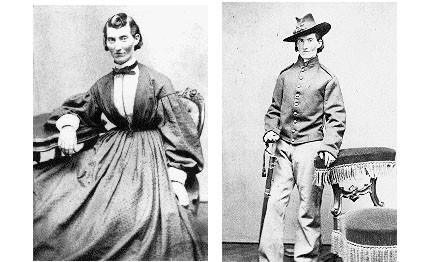
That brings me to female reenactors portraying soldiers.  This is a little bit of a controversial topic.  I can’t tell you how many new women coming into the hobby proudly declare that they will be disguised as males and joining the fighting because it’s much more fun.  It makes me cringe every time I see a female reenactor on the battlefield.  It’s not because women didn’t fight in the war.  There were women who fought in the war but far less than what is being portrayed by reenactors.  High estimates in the Confederate army placed female soldiers at only 250 while estimates in the Union Army place female soldiers at 400.  Considering this war was made up of roughly three million soldiers, we are talking about a very, very small percentage of females disguised as men.  The amount of women portraying soldiers in reenacting today makes tourists think that the numbers were much higher, which is not at all accurate.

The other part of female reenactors portraying soldiers is that they are easily recognizable as females.  In the 1860s, women who were caught in the military were sometimes jailed, but at the very least, they were kicked out of the army and sent home.  Being recognized, to them, was a matter of life and death, so they did everything humanly possible to conceal their identities.  When it’s done accurately, you should not be able to tell the difference between a female and, say, a teenage boy soldier.  But the women who are doing it now are very easily spotted because they’re not concealing themselves enough.  I am personally of the attitude that if you’re going to do something, you should do it right.  So when women come to me saying they want to be a soldier, I usually try to talk them out of it because there are so many doing it already.  If more excitement is what’s desired, my suggestion is doing an impression based in espionage.

Determining what kind of person you are going to do for your impression (again, you don’t need to do someone who actually lived – you can build your own based on your research) is going to determine what kind of equipment you bring with you, what kind of clothing you wear, how you speak, what sort of back story your building, and so forth.  You need to keep in mind who you are in the present as well because a 35-year-old woman is not going to portray a 16-year-old girl, for example.  Here is a questionnaire that is designed to help you flesh out your impression, much like you would flesh out a character in a novel or a play.  This is designed to give dimension to your portrayal and help you understand what kind of things you need as far as clothing and equipment.

Fleshing out Your Impression Questionnaire

Directions: answer this questionnaire as if speaking in your first person persona between 1861 and 1865.  This will require some research into the type of people who lived in your area at that time.

1.  How old are you?

2.  What is your marital status?

3.  Where do you live?  (City home, farm, boarding house, refugee, etc.)

4.  What is your financial status?

5.  Which of your male relatives are serving in the war?  Confederate or Union?

6.  Have you or will you volunteer in any relief societies?

7.  What is your religious background?

8.  What is your educational background?

9.  Do you have any special talents?  (Painting, embroidery, music, etc.)

10.  Describe your daily routine.

11.  Describe your feelings on the war, slavery, the current political climate, etc.

Continue on to The Lady Civil War Reenactor: Part III now.

Read More

The Lady Civil War Reenactor: Part I

Posted by Jessica Jewett 5 Comments »

Introduction

People new to Civil War reenacting often find themselves overwhelmed by all of the work required to do it correctly. I’m here to impart my experiences, tips and tricks drawn from 16 years of periodic participation in such reenactments. I’m starting from scratch with the assumption that the reader has never even attended a reenactment as a spectator just to keep everybody on the same page. If you have questions at the end of each blog in this series, please put them in the comments at the bottom. I’ll either use the questions in a Q&A blog at the end or I’ll use them as we progress.

Why People Reenact

Reenacting any period of history is about experiencing what the people at that time did while educating the public. Individual reasons for doing it vary. Some people do it because they’re naturally theatrical and the possibility of acting on a very large stage appeals to them. A great many do it because they have ancestors who fought in the war and they want to know what their blood went through to be here today. Many do it because they simply love exploring history in a tangible way. There are also quite a few active and retired men from our current armed services who reenact the Civil War in their spare time as well. They seem to find comfort in the natural camaraderie that develops among the other reenactors just as it would in their own military service.

And then there are sub-reasons not so talked about like the reasons that got people into it in the first place. They’re more like side affects of the hobby, such as the paranormal. Most reenactors have had experiences with the spirits of Civil War soldiers and other people of that period. They don’t talk about it right away though. It takes time for them to open up about it from what I have seen. Perhaps they’re afraid of ridicule. The amount of reenactors who have had spiritual experiences is astounding, and the experiences are not just limited to the more liberal types. I’ve heard a lot of stories from big, tough, highly reserved and conservative men. There is also a giant elephant on the battlefield, so to speak, of reincarnation, although they’re much less likely to talk about that openly. I’ve heard enough in private from many reenactors to make me realize that there are a lot of soldiers and civilians still fighting out their past lives by reliving them at reenactments.

How a Reenactment Works

The construction of a reenactment is basically the same whether you’re at a small event or a mainstream event (we’ll go over reenactor language soon). They don’t usually take place on the actual battlefields because they are now national parks that cannot be damaged, although there are some that do. Usually someone nearby with a large piece of empty property will rent out their land for the weekend.

The first morning is about reenactors arriving, setting up their camps, and generally preparing for the onslaught of tourists. Once you’re in camp and the vehicles are removed, the majority of reenactors will remain in period clothing and live the period way for the entire weekend whether tourists are watching or not. That is, after all, the only way to do it if you’re really there to live the Civil War. You should have a period correct tent or borrow one or share one, proper blankets, proper cots if necessary, proper storage items such as carpet bags or wooden crates, etc. Anything modern needs to be disguised inside of something period correct. We’ll go over a supply list later. Sometimes tourists assume our camps are just for show and we don’t actually use them, but we do, and the reenactors who go to hotels at night are in the minority. (I call them the Hotel Brigade.) If you question whether you’re tough enough to camp the period way for the entire weekend, let me impart some encouragement on you: I’m a quadriplegic and I sleep on the ground like everybody else. If I can do it, so can you. At the bigger events, you are usually provided with things like firewood, water and some meals. At the small, hardcore events, you’re on your own because people in the 1860s were on their own.

Tourists start arriving around mid-morning and they wander around the different sutler tents, often set up in what’s called Sutler Row. A sutler is a place that, during the war, soldiers could buy extra food, clothing, supplies, etc. In the reenactment translation, a sutler is where tourists can buy books, movies, souvenirs, and so forth, while reenactors can buy new items for their impression like clothing, jewelry, weaponry, accessories, and so forth. Additionally, there may be activities for tourists to watch, like ladies tea parties (sometimes those are private though), listening to soldiers teach about the war, observing staged surgical procedures in the medical tents, watching companies drill, different lectures sometimes, period music performed by bands, and a number of other scattered activities. It really varies depending on the reenactment. Tourists are always very interested in the camps. If a reenactor has a special skill to demonstrate like sewing or cooking over a fire or anything else, they’ll often stay in camp and demonstrate those things for tourists. If you leave your tent flaps open, expect tourists to look inside (this is why it’s so important to do everything as period correct as possible). They will ask questions about what you’re wearing, what your doing, your belongings, etc., so it’s also very important that you know your history.

The battles usually take place midday or in the afternoon. Most of the morning, the men will be getting organized, checking their weapons, and doing drills, so women and children are usually on their own. It’s important as a woman to develop your own interest and niche in reenacting because you’re going to be awfully bored if you’re doing it just to follow your husband. The battles begin with the soldiers marching from camp to the field while the tourists pile up at the field barricades to watch. Obviously live ammunition is not allowed but the shots are blanks and still make a lot of noise. Depending on the size of the reenactment, there may be a few cannons or a lot of cannons. Small children or people with anxiety disorders or heart problems may not be good candidates to watch reenactments because of the loudness of cannon fire and the action. The women reenactors usually come along from camp and watch the battle with the tourists. They’ll often answer questions and explain what’s going on as well.

After the battle is over (they usually last about an hour or two sometimes), many of the tourists will go home. Some will stay for a while and keep walking around. Usually all of the tourists will be gone by 4 or 5 in the afternoon but definitely all are gone by sundown. That’s when the reenactors relax and spend the evening socializing, having supper together, and there is usually a ball on Saturday night. At the ball, women have a better chance at mingling with men. It usually takes place in a very large open tent with a live band playing period music. There will also be a few experts on hand teaching period dances to people that haven’t attended a ball in the past. Reenactors will wear their formal clothes if they have them and the dancing will go on pretty late into the night. For women, the ball is usually the highlight if the weekend.

The last day, people pack up their things, put on their regular clothes, and say their goodbyes. When the weekend was especially good, sometimes it can be as tough as going home from summer camp! Many of the reenactors already know each other from other reenactments or living histories. The reenacting community is rather like a small town, so if you’re a fairly regular participant, people who don’t actually know you will know you by reputation soon enough. And like a small town, the reenacting community also means people will know your business and vice versa. The gossip aspect of it is very much an undercurrent at these things, but that’s true whenever you put the same people together in an isolated location for repeated weekends. The key is to make friends with everyone as best as you can and avoid participating in the gossip. Build a reputation of honor for yourself. It’ll win more respect at the end of the day than knowing everybody’s business. For the most part, reenactors are good people but there will always be a few bad apples in any hobby, sport, school or workplace. It’s the nature of the beast.

Reenactor Vocabulary

The reenacting lifestyle has its own language. If you participate in even one reenactment, you’re going to hear the language, so it’s important to understand it as quickly as possible. I found a list of common terms for you all. Most of these terms apply to soldiers but it’s important for women to understand them as well because you need to be able to communicate with the soldiers. I took an existing list and added a few more terms that I’ve heard passed around over the years. I also added some terms that apply to ladies.

Artillery – The unit that operated the cannon, mortar and heavy weapons.

Ballgown – Formal evening gown for women made of the best materials a woman can afford for her impression. It’s usually off the shoulders and short sleeved.

Battle Reenactment – Scripted battles are reenactment in the strictest sense; the battles are planned out beforehand so that the companies and regiments make the same actions that were taken in the original battles. They are often fought at or near the original battle ground or at a place very similar to the original. These demonstrations vary widely in size from a few hundred fighters to several thousand, as do the arenas used (getting the right balance can often make or break the spectacle for the public).

Bonnet – A head covering for women made of quilted fabric, straw, felt and a variety of decorative things like flowers, fruit, birds, lace, and they tie under the chin with ribbon.

Brogans – low quarter shoes that are period-appropriate for the Civil War, particularly common with enlisted soldiers.

Bummer – A forage hat.

Camp Dress – Very simple dress usually worn without hoops and made of inexpensive fabric that can easily be replaced. Worn for working around camp by fires and worn for impressions of civilian refugees.

Cavalry – A unit that traveled and fought on horseback. The hallmarks of a cavalry unit were speed and mobility.

Character Reenactors – Some reenactors portray a specific officer or person such as General Robert E. Lee, U. S. Grant, President Jefferson Davis or Abraham Lincoln, or a less well known officer such as Col. Abram Fulkerson. Character reenactors may also portray a civilian man, woman, or child of significance. These reenactors often do not participate in the actual combat portion of the reenactment and serve as narrators to the audience during the battle. Often, character reenactors have extensively researched the person they portray and present a first-person narrative of his story.

Chemise – Undergarment worn by women that resembles a nightgown made of white cotton. It’s short sleeved, shapeless and hangs to about mid-calf, worn under the corset, petticoats and hoops.

Civilian – A person who reenacts a non-military impression during reenactments. Many people create extensive civilian impressions to participate in reenactments.

Colors – The flag. This refers to the unit flag, the state flag, the national flag – any flag on the battlefield. A unit’s colors were not only a form of communication but a banner of great pride during the Civil War, one to be defended to the death.

Combat Demonstration – Combat demonstrations are mock battles put on by reenacting organizations and/or private parties primarily to show the public what combat in the period might have been like. Combat demonstrations are only loosely based on actual battles, if at all, and may simply consist of demonstrations of basic tactics and maneuvering techniques.

Commercial Reenactment – Many castles, museums, and other historical tourist attractions employ actors or professional reenactors as part of the experience. These usually address the recreation of a specific town, village, or activity within a certain time frame. Commercial reenactment shows are usually choreographed and follow a script. Some locations have set up permanent authentic displays. By their nature, these are usually living history presentations, rather than tactical or battle reenactment, although some host larger temporary events.

Corset – Female undergarment made of cotton with stiff supports made of whalebone in history and steel boning in the present. The front closes with hooks and eyes while the back is secured with laces. It’s an important piece to the period correct impression and gives the body the correct 1860s silhouette.

C.S. or C.S.A. – Confederate States or Confederate States Army

Day Dress – More decorated and fancy than the camp dress. Worn when women were socializing in the daytime rather than doing housework or camp work.

Dismounted Cavalry – A hybrid of infantry and cavalry. Dismounted Cavalry traveled by horseback but normally fought on foot.

Drill – The unit practicing maneuvers or marching. Typically a unit will drill prior to a reenactment to learn particular moves that will be used in the battle.

Facing the Elephant – The Civil War soldier’s term for going into battle.

Farby – A reenactor’s term for anything not period-appropriate. Reenactors try to avoid “being farby” – some go to great extremes (see the definition of “threadcounter”). As you develop your impression over time you can replace items that are not period-appropriate in your uniform and camping setup. This may include anything from getting period gear for your tent to picking up authentic wire-frame glasses.

Federal – the Northern Army. Also called Union.

Forage Hat – similar to a kepi but taller on the top so that it falls forward to the bill of the cap.

Hoops or Crinoline – Undergarment designed to support the weight of petticoats and a dress to give the 1860s silhouette a bell shape.

Impression – A fictional persona of someone living during the Civil War that has been created by a reenactor. The reenactor then takes the role of the impression. Impressions can be military or civilian.

Infantry – The foot soldiers who marched into battle.

Kepi – The standard hat you think of as a Civil War hat.

Living History – Another name for reenacting. A living history event might include a static display or presentation at a school or community occasion. Living history events are designed to educate the public on a soldier’s life during the Civil War.

Mainstream – Mainstream reenactors make an effort at appearing authentic, but may come out of character in the absence of an audience. Visible stitches are likely to be sewn in a period-correct manner, but hidden stitches and undergarments may not be period-appropriate. Food consumed before an audience is likely to be generally appropriate to the period, but it may not be seasonally and locally appropriate. Modern items are sometimes used “after hours” or in a hidden fashion. The common attitude is to put on a good show, but that accuracy need only go as far as others can see.

Maximum Effort – An event where all members are strongly urged to attend.

Mourning Dress – Dress typically made of black crepe worn by women in periods immediately following the death of a loved one.

Muster – A gathering, especially of troops, for service, inspection, review or roll call.

National Event – A large event, commemorating an actual battle, normally attended by units nation wide.

Period-Appropriate – If something (clothing, weapons, camping gear, etc.) is in the same form, style and manufacture as it was during the war, it is said to be period-appropriate. Also known as period correct.

Petticoat – Undergarment for women worn like a skirt but it’s made of white cotton. It provides warmth and adds volume to the 1860s bell shaped silhouette. Worn in multiple layers.

Progressive or Hardcore – Sometimes derisively called “stitch counters”, “authenticity nazis” or even “stitch nazis”, many people have misconceptions about hardcore reenactors. Hardcore reenactors generally value thorough research, and sometimes deride mainstream reenactors for perpetuating inaccurate “reenactorisms”. They generally seek an “immersive” reenacting experience, trying to live, as much as possible, as someone of the period might have. This includes eating seasonally and regionally appropriate food, sewing inside seams and undergarments in a period-appropriate manner, and staying in character throughout an event. The desire for an immersive experience often leads hardcore reenactors to smaller events, or to setting up separate camps at larger events.

Reenactor – A person who recreates the War Between the States or Civil War as a soldier.

Tactical Combat – Tactical battles are generally not open to the public. Tactical battles are fought like real battles with both sides coming up with strategies and tactics to beat their opponents. With no script, a basic set of agreed-upon rules (physical boundaries, time limit, victory conditions, etc.), and on-site judges, tactical battles can be considered a form of live action role-playing game, but, in the cases where firearms are used, with real weapons firing blank ammunition (depending on gun control ordinances).

Threadcounter – A reenactor who insists on a historically accurate impression, right down to having a uniform made of the correct fabric, with buttonholes having the same threadcount as those uniforms worn in the 1860s. The opposite of a threadcounter would be “farby” (definition above). Also known as Stitch Nazi, Progressive or Hardcore.

Sack Coat – the standard coat for Civil War soldiers. A simple style of coat that was easy to produce in large quantities.

Shell Jacket – Cut shorter than a sack coat, the shell jacket extends down to the waist. It can be worn buttoned up, completely open or buttoned only at the top.

Slouch Hat – Similar to what many refer to as a cowboy hat, the slouch hat was worn by officers and enlisted alike. Particularly for Union soldiers, the slouch hat would have a colored braid to indicate the type of unit that soldier was with – yellow braid meant cavalry, blue braid meant infantry and red braid meant artillery. This helped commanders identify their troops from long distances.

Sutlers – Merchants who followed troops during the Civil War. Today, modern Sutlers set up tents at reenactments to sell a wide variety of uniform items, clothing, tools, equipment, souvenirs and other Civil War-related items.

Union – the Northern army. Also called Federal.

Continue on to The Lady Civil War Reenactor: Part II now.


Read More

Categories