

>Governor Joshua L. Chamberlain’s Thanksgiving Proclamation

Posted by Jessica Jewett No Comments »

>

In 1867, Joshua Lawrence Chamberlain, my former husband, was the new Governor of Maine after serving an illustrious career as an officer in the Civil War. He was Maine’s first postwar governor and elected on the Republican ticket, which, at that time, was much more like the present Democratic party. In the 1860s, there was no official governor’s mansion in Maine’s state capital of Augusta. Mrs. Chamberlain, the First Lady of Maine (me), remained back home in Brunswick raising the children while Lawrence served four terms as governor.

Thanksgiving in Maine had existed since the colony was founded but before President Lincoln declared the official national holiday, each state in New England celebrated on a different day. Back then, Thanksgiving was more about celebrating the harvest but the tragedy of the Civil War reshaped the way we celebrate the holiday today. Governor Chamberlain’s Thanksgiving Proclamation reflects the mood of the country in mourning the staggering losses in the war while trying to heal the emotional wounds everyone suffered. Governor Chamberlain’s Thanksgiving Proclamation was issued to be celebrated in April but several days in the year were often proclaimed for these purposes in the country in history. A very similar attitude would have been adopted for the traditional November holiday. Thanksgiving in Maine equivalent to our holiday was typically held around November 18.

Here is the image of his actual Thanksgiving Proclamation and the text is below that:
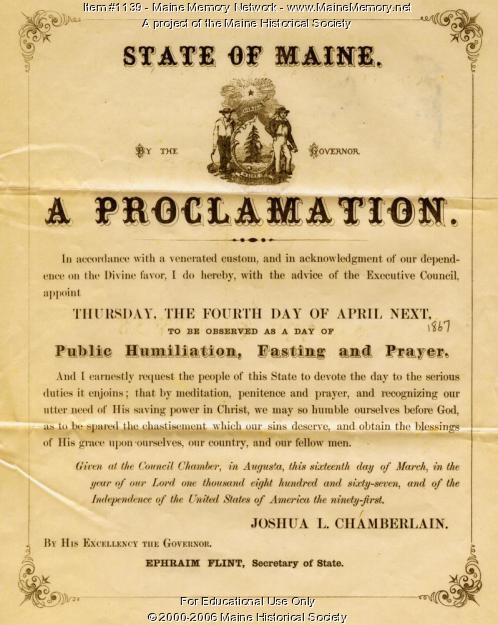
State of Maine.
By the Governor.
A Proclamation.

In accordance with a venerated custom, and in acknowledgment of our dependence on the Divine favor, I do hereby, with the advice of the Executive Council, appoint

Thursday, the Fourth Day of April next,
to be observed as a day of

Public Humiliation, Fasting and Prayer.

And I earnestly request the people of this State to devote the day to the serious duties it enjoins; that by meditation, penitence and prayer, and recognizing our utter need of His saving power in Christ, we may so humble ourselves before God, as to be spared the chastisement which our sins deserve, and obtain the blessings of His grace upon ourselves, our country, and our fellow men.

Given of the Council Chamber, in Augusta, this sixteenth day of March, in the year of our Lord one thousand eight hundred and sixty-seven, and of the Independence of the United States of America the ninety-first.

Joshua L. Chamberlain.
By His Excellency the Governor.

Ephraim Flint, Secretary of State.

Read More
>Dressgasm of the Day: 1860s burgundy mantle

Posted by Jessica Jewett No Comments »

>

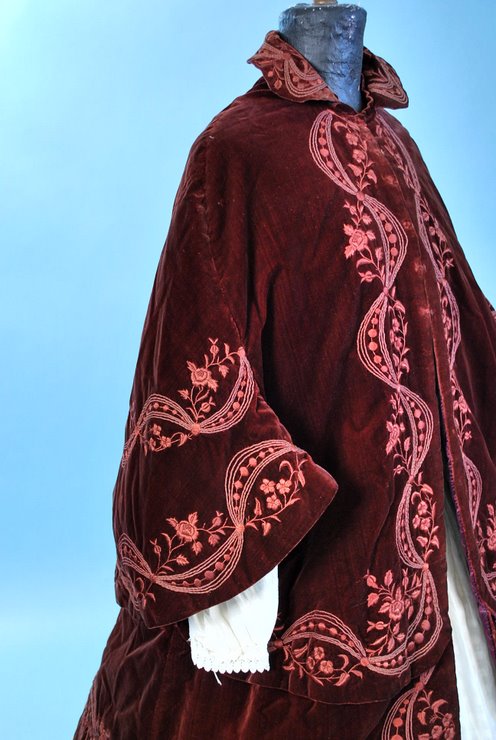
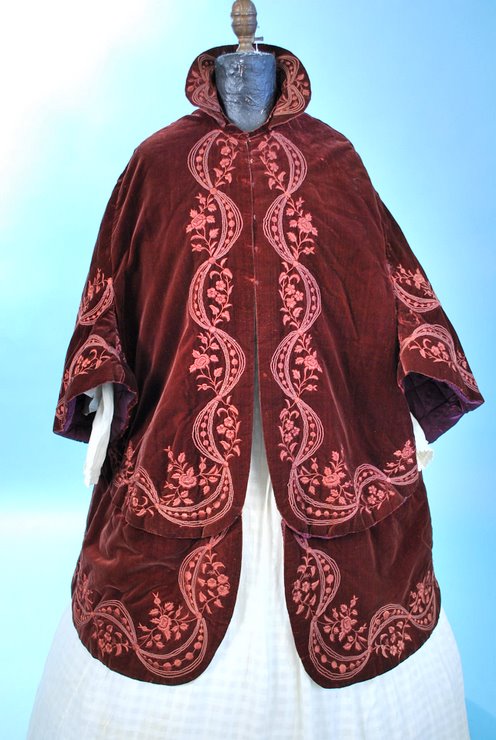
Since winter is approaching, I thought I would discuss a piece of winter clothing from the 1860s. Most people believe men just had their long duster jackets and women had their long, romantic-looking cloaks made of unfortunately boring material. That isn’t true at all. Women had a great many different style choices for winter attire, ranging from short little shoulder wraps, to mid-length mantles with or without sleeves, to cloaks, to full-length coats with sleeves as we know them today. Of course, there was also the classic shawl that was used year-round in different types of fabrics for lightness in the hot months and heaviness in the winter months.

This particular cloak is gorgeous not only in its colors of burgundy and pink but also in its scrollwork detail. I don’t know very much about this mantle but it appears to be made of either wool or possibly some type of velvet. It’s more likely to be wool or a wool blend, however. The sleeves are bell-shaped, which are called pagoda sleeves, and the mantle fastens down the front with either hooks and eyes or frogs dyed pink to match the pink decorative detail. I cannot discern exactly what the pink detailing is made of but it might be silk embroidery or silk pieces sewn to the mantle. Most of the time, the details were made of silk if they were done that intricately.

Read More

>Dressgasm of the Day: 1860s or 1870s cotton

Posted by Jessica Jewett No Comments »

>

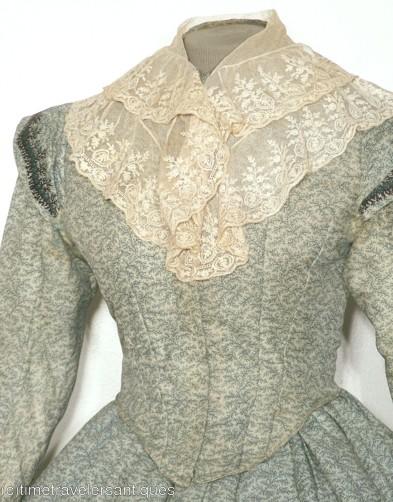
Today’s dressgasm is an interesting choice because I feel that it was originally a late 1850s or early 1860s dress that was altered in the 1870s to continue being worn in that decade’s fashion guidelines. I would classify this dress as a visiting dress, walking dress, etc. That sort of thing. By that, I mean the lady probably wore this dress in the daytime when she intended to be seen by her friends, strangers on the street, and yes, her enemies. Women of the nineteenth century were no different than the women of today with having the desire to dress to impress when they were out and about visiting people, shopping and so forth.

I believe this dress is made if lightweight cotton or possibly cotton blended with wool. The bodice may be lightly boned, given the firm shape and long point at the waist. There is a delicate design printed on the fabric and around the sleeve caps are black lace accents with black around the cuffs with ivory lace accents.

The reason why I feel this dress may be a blend of several different decades is the fact that the skirt is the classic bell shape of the 1850s and 1860s, while the bodice shape and sleeves don’t exactly fit the standards of those decades. The sleeves are quite tight without an exaggerated elbow and the shoulder seams are higher than what was fashionable before and during the Civil War. Another clue that the bodice was altered later is the lace draped over the shoulders and over the bosom, which became the fashion in the 1870s. All of these aspects give me a good impression that the dress was altered. Women who were not so wealthy often used and reused clothes as long as they could to make the most of the money they spent on the fabric and trim to make the dress. Since this dress was not silk and the design was not terribly complicated, I do not believe this lady was of any great wealth. This was probably her best dress.

Read More

Categories