

Do you like this From the Darkness Risen: Book II book cover design?

Posted by Jessica Jewett 5 Comments »

This book cover has been giving me fits for months. Today I jigsawed some things together that look halfway presentable and I need to know if this book cover would catch your interest if you were browsing for novels. I used an 1865 painting of a widow by a Russian artist with a modified painting of the 1865 Sultana disaster. Modified means my friend, Cindy, wiped out the word Sultana from the steamer for me because the Sultana is not actually featured in the story. A little transparency filter, a little text, bingo, bango, I have a book cover design. I’m an independent author, so I can’t afford a cover designer, nor do I have time to wait for someone else to do it (call me a control freak if you must). Here’s a summary of the novel to help you.

Book II finds the Cavanaugh family and the Grimm family living in separate not only separate states but separate countries amidst the ever darkening American Civil War. Having physically recovered from his escape from a Union prison, Robert Cavanaugh is a withdrawn and troubled man raising his children in his mother-in-law’s Charleston home. The need for purpose and fulfilling his duty sends Robert to a recruiting position in the Confederate Army while his wife, Isabelle, endures a difficult pregnancy in a city quickly becoming strangled by the Union blockade. She grapples with the cracks exposed in her marriage, uncertain if her family will survive further Yankee invasion. The wedge between Isabelle and Robert grows when tragedy strikes their young family, followed by the unexpected arrival of her brother, who brings the blackness of the war home with him. Will their faith carry them through to the end of the war? Will their marriage survive the ravages of heartbreak, secrets, and a country in ruins?

Meanwhile, a world away in divided Missouri, Eva Grimm is bored with her position as the new wife of a St. Louis University professor. The monotony of a housewife’s simple existence without servants and the gayety of her former life as a Charleston socialite leaves Eva despondent until she receives a mysterious invitation to a Confederate safe house. There she discovers a ring of Confederate operatives looking for recruits upon the recommendation of none other than Drusella Sappington. Excitement and duty to her country fills Eva once more as she becomes more and more drawn into the underground war effort along the Mississippi River. The only problem is her quiet scholarly husband. Thaddeus swore he would divorce her if she ever lied to him again. As Eva finds herself leading more and more of a double life with more dangerous assignments such as planting Greek fire bombs on river steamers carrying Union supplies, she knows her secrets are a ticking timebomb. Thaddeus pressures her to have a baby but she doubts her capacity for motherhood. And as Benjamin Geary resumes his obsession with Eva, she becomes more convinced than ever that he would harm her child if she became pregnant. What will Thaddeus do if he discovers the truth about his Southern wife? Will Benjamin finally succeed at hurting Eva if he realizes he can’t have her? Will the pro-Union government in Missouri discover the Confederate operatives living right under their noses?

Okay, so that’s basically the direction of Book II. Now take a look at this cover and tell me what you think. Does anything need to be shifted? Does the title color pop? Does it need anything else? Thanks!

UPDATE!!!!!!!!!!!!! With an obnoxious number of explanation points.

I received several suggestions concerning the proposed book cover and I made some changes. The title has been rearranged as well as the slight color change and the change in font to “Book II” and “Jessica Jewett” because they weren’t clear enough. Additionally, I adjusted the colors on the paintings to make them fit better. The steamer has been moved up a little bit to improve the proportional flow of the cover, making it easier on the eye to see the steamer shape. Muting the fire’s intensity seems to have made it better on the eye as well. I also gave a little more color to the lady because the fire had, in my opinion, washed her out in my opinion. She has to look like she’s being consumed by the fire.

Do you like this version better? Please let me know.

Read More

Queen Mary’s wedding dress

Posted by Jessica Jewett 1 Comment »

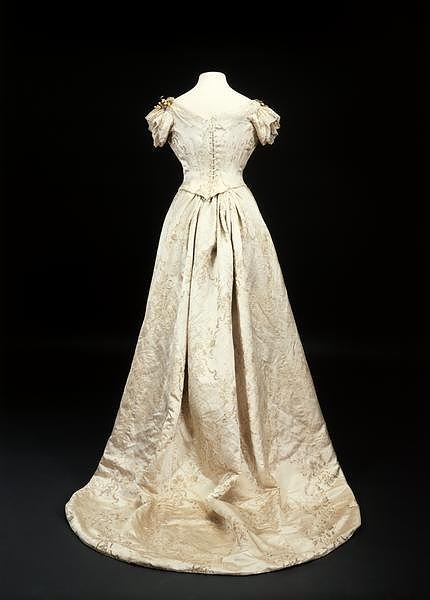
I have an interest in the history of the royal families of Europe, as you know, so when I saw Queen Mary’s wedding dress, I loved it immediately. She was Mary of Teck, the wife of George V, who both were our current Elizabeth II’s grandparents. George V was Queen Victoria’s grandson, making Elizabeth II her great-great granddaughter.

Mary of Teck married George, the Duke of York, on July 6, 1893 in the Chapel Royal at St. James’ Palace. She was first engaged to Prince Albert Victor but he died before they were married, so Queen Victoria offered her next son, the Duke of York. He was told to either marry Mary or Princess Marie – who refused his proposal, leaving Mary as the only choice. The Queen liked Mary and the press was putting as much pressure on them as their families were even though she was still mourning the death of Albert Victor. Since Princess Marie had rejected the Duke, he wasn’t sure how Mary would receive him and he lost his confidence until Queen Olga of Greece stepped in to offer encouragement. From Wikipedia: “Several awkward encounters with Prince George went by, always in the company of others, with both individuals remaining embarrassed and shy. On 3 May 1893, Mary arranged to have tea with George’s sister Princess Louise, Duchess of Fife and her husband, but when she arrived, she found George there as well. The awkward moment was saved after Louise interceded, ‘Now Georgie, don’t you think you ought to take May into the garden to look at the frogs in the pond?’ George proposed beside the pond, and their engagement was officially announced the following day.”

The day of the wedding, George accidentally saw Mary in a long corridor at Buckingham Palace. He responded by giving her a deep, courtly bow and she never forgot it. Much like royal weddings today, enthusiastic crowds greeted the wedding party on the streets of London, which included ten bridesmaids who were all princesses in their own rights. Again from Wikipedia: “Mary’s wedding dress had a train of silver and white brocade, and was embroidered with a design of rose, shamrock, and thistle in silver. She wore the same bridal veil as her mother Princess Mary Adelaide, Duchess of Teck had in 1866 – it was small, and hung down the back of the head. Her trousseau consisted partly of ‘forty outdoor suits, fifteen ball-dresses, five tea-gowns, a vast number of bonnets, shoes, and gloves,’ as reported by the Lady’s Pictorial. The couple received equally lavish wedding presents, such as jewelry and plates valued at £300,000.”

Now that you know the story, take a look at the dress and the wedding photographs.

Read More

John Wilkes Booth and the little girl in Richmond

Posted by Jessica Jewett No Comments »

My friend asked me to transcribe a newspaper article for her about John Wilkes Booth’s personal interactions with a little girl in Richmond before the Civil War. It sheds interesting light on him, so I decided to post it here, although the article may be somewhat clouded with hindsight. With the benefit of the passage of time, people tend to look at the past through rose colored glasses, and little girls are very prone to hero worship. I do think there is a great deal of truth in her account but possibly a little flowery and romantic in recollection. Take a look and judge for yourselves.

Wilkes Booth’s Ring.

[Mary Belle Beale in Philadelphia News.]

“Many and many a night we would return home with my father after the play was over. There was always a warm supper and a warm welcome for my father’s guests after the theater doors were closed. Those were the days of stock companies, and Richmond has been the cradle in which many of the now famous American actors were first taught to test their strength. Almost every night my father would drop in the Richmond theater, where he had a box, and it was very seldom that he came home alone. The first thing that Wilkes Booth would do would be to make for the nursery, where I lay asleep. He seemed a giant to me when he would hold me up aloft and straddle me across his shoulder. I remember one night his taking me down stairs and sitting me on a silver butter salver that stood embedded in flowers in the center of the table, whence I was rescued by my colored mammy, whose muttered ejaculation was: ‘Them play actors is the debble.’

“He was passionately fond of children. I’ve heard my mother tell about a play he used to act in, in which there was a child. ‘The Sea of Ice.’ I think it was, and she said he was so loving to the little thing that she would nestle in his arms in the wings until her time came to go on the stage.

“Just before the blockade began which divided the north and south, when the cannon had announced that Virginia had seceded, Wilkes Booth and the Richmond stock company seemed to disappear in the mist that was rising to overcloud the once united country. ‘Masks and Faces’ was the last performance given at the old playhouse that had once sheltered so gay a crowd.

“Just about that time I seemed to dream one night that somebody kissed me and put something on my finger. I was very much surprised to find next morning a little gold ring with ‘Regard’ in blue enamel on it in my bed. My mother took the ring to keep it for me until my finger grew to its size and she told me Wilkes Booth had gone away but she hoped to see him again. Mr. Booth was such a favorite with those who knew him, for he was brave, ardent and affectionate–three powerful qualities which are strong claimants upon the southern heart.

“Well, the days passed while I was running around in my homespun frocks, and soon the south was a conquered nation, and then came the terrible tidings of Mr. Lincoln’s assassination by the hands of him who had ever been so gentle and loving in the sunlit past. Ah, those were curious days when they took the little ring and hid it for fear my tongue might babble of that which I never knew. What did I know about assassination, or about rule or misrule?

“I only knew I should never feel those strong arms lift me again. I only heard my childhood’s friend had suffered the felon’s doom.

“There was a little girl with two blonde ‘pigtails’ on her shoulders and a world of defiance in her near-sighted eyes that sat, whenever she could steal away, down in the garden where the dandelions and violets carpeted the April robed terrace. My ring was there, and there I sat like some small but resolute Rizpah, alert to drive away all who would molest my treasure.

“I didn’t know anything about politics, and I was more sorry than I could tell for the president, whose kind eyes I had seen as he drove the week before through our town. I was thinking of the hands that would clasp mine no more as I guarded the ring of him whose heart was once so full of love for little children.”

Read More

Categories