I’m going through my storage bins of Civil War reenacting stuff because I’m going to the Battle of Resaca in May. I haven’t done this in several years due to bad health and a relapse of my anxiety disorder. But this year, I plan to start getting back into it.
As I was going through my storage bins, I realized some of my stuff is different because I’m a quadriplegic. So I wanted to write about it a little bit, maybe hoping that other disabled people might see that it’s possible to do something like reenacting too. And reenacting is not completely like theater or even cosplay if you think about it. We invest a lot of time, energy, materials, and resources into our Civil War personas the way those in the theater or in cosplay do. So if I can do it from a wheelchair, you can too.
This is 2014 me:

And this is 1863 me:
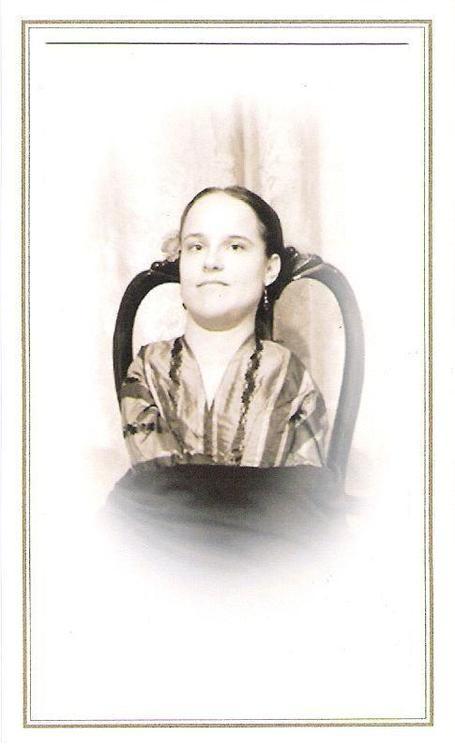
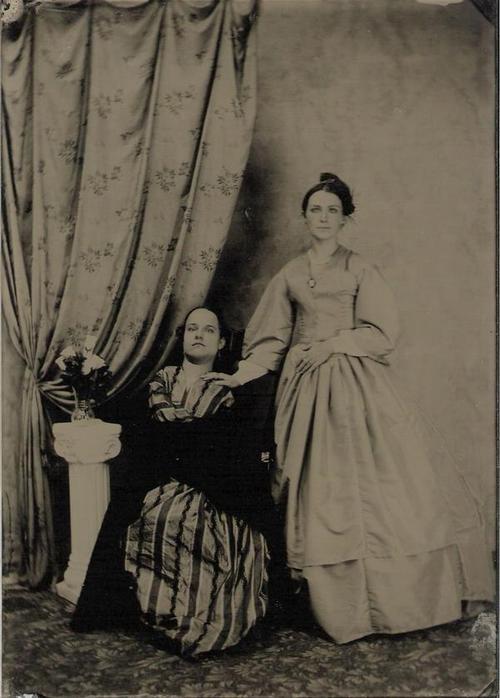
It’s not easy to discern my quadriplegia when I sit for glass plate photographs, right? It’s not accidental. Wherever possible, like any great actress, I do what I can to convince the viewer of the part I play. For photo sittings like these, I transfer from my wheelchair to a regular antique chair the photographer has in his or her period correct studio. A 21st century wheelchair would destroy the historical illusion.
Also, I hide the deformities of my hands by wrapping myself in a shawl. Both the dress and the shawl I’m wearing in these photos are from the mid-19th century. Normally, I would never advise anyone to wear real antique clothing because they’re fragile. Once you rip these things or get them dirty, you can’t fix them. I happen to be as small as the average woman in 1860 (five feet and less than a hundred pounds), so these old clothes tend to fit like they were made for me. I don’t walk around either. I’m like a sitting mannequin. So for these pictures, I decided to wear the real thing instead of my usual reproductions. The black wool shawl dates to 1860 and the purple and green dress dates to 1865, I believe. It was altered numerous times over the decades.
But I can’t sit in regular chairs all the time. They’re painful, otherwise I wouldn’t need a wheelchair. My wheelchair doesn’t exactly fit the 1861-1865 period. And this is where, if you have modern adaptive equipment like this, you’re going to run into some trouble. There are hardcore groups that won’t admit women at all, let alone a quadriplegic woman. In the 19th century, my mother and I would have died in childbirth. If I had survived, I would be shipped off to an institution and never, ever seen on or near a battlefield. So there will be reenacting groups that will reject you based on both your gender and your disability if they strictly adhere to history. Don’t bother fighting it because they’ll never change. There are plenty of reenacting groups who will welcome you with open arms into their civilian detachments.
If you can afford one, this is a wheelchair correct for the 1860s:
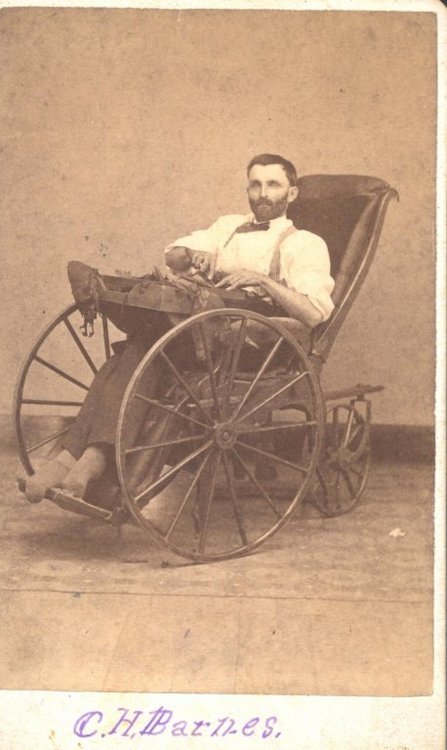
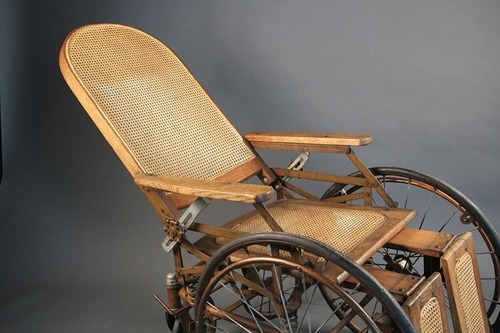
I’ve never seen one go for less than $3,000 though. One of my old wheelchair dealers (yes, it’s kind of like a car showroom) had one on display and I used to die over it. If you have a handy person in your life, you could improvise one from a wicker chair or another chair that looks authentic to the period. I’ve seen museum pieces that look like people just slapped wheels on a dining chair for an invalid relative. That can be costly too but not like buying an antique.
However, if your disability is rather severe like mine, this is not an area that can be compromised. I can’t sit in regular chairs very long unless they recline. So I use my own wheelchair and I’m not the only one. You won’t be in the minority of disabled reenactors if you use your own adaptive equipment because period correct adaptive equipment is rare and expensive.
Here is said wheelchair:
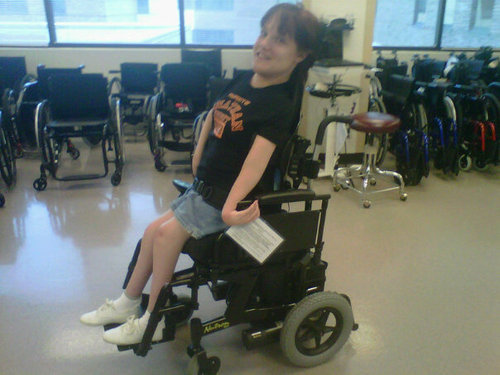
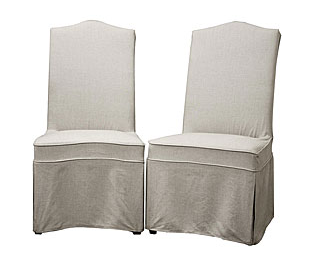
Never fear, reenactors! I come bearing suggestions for disguising your modern wheelchair. The quickest, easiest solution is to throw an old-fashioned quilt over the wheelchair before you get into it. That works pretty well if you’re in a manual chair but some types of chairs require access to a hand box for driving. So what you can do is take a quilt that you don’t need anymore and get someone who’s good with a needle to sew a fitted slip cover over the chair. That way you can customize it so it won’t drag the ground or get caught up in the wheels, yet still covers the modernness of the equipment. Cut a hole and sew a proper seam around it where you need access to the driving stick or any other buttons you need. At the very least, you can have slipcovers sewn of 19th century appropriate fabrics to put over your seat pieces. It makes you look like you’re sitting on 19th century cushions.
This is a modern example obviously, but think of slipcovers along these lines made from 19th century appropriate fabrics to conceal your modern wheelchair parts:
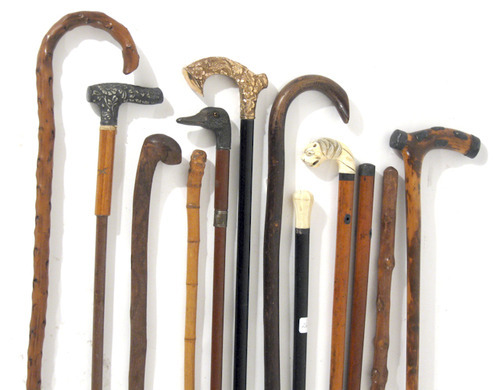
If you use a cane or a walker and you reenact enough, it might be worth the investment of getting someone handy to build a replica of your modern equipment out of wood. Or get an extra cane or walker and cover it with sticky fake wood, which will conceal much of the modern colors and materials used for these things. I know some people who have gotten antique walking sticks to use in place of their regular canes at reenactments. While walkers were not used in the mid-19th century, creating replicas of modern adaptive equipment out of 19th century materials helps create the historical illusion.
Victorian canes:
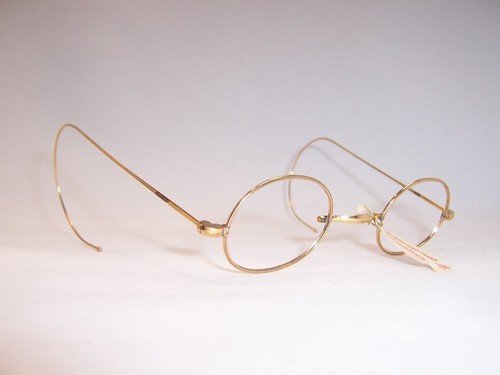
Do you wear glasses? You can find antique or reproduction glasses frames and have your prescription lenses put into them. And there you can still see what’s going on but you still continue the illusion of stepping out of the Civil War period.
Victorian glasses:
For women, Civil War clothing can be restrictive and uncomfortable on whatever disability may be present. There are ways to get around adaptations while still being as accurate to the period as possible.
The corset is the most difficult thing to make work when your body is bent in different places like mine. A lot of female reenactors without disabilities choose to forego corsets altogether even though the corset was a vital piece to the 1860s silhouette. You simply won’t get the correct body shape and your clothing won’t sit right on your body without the corset to provide bodily stability and support the weight of so many layers.
This is the last time I tried on my corset when I was making new clothes in 2010:
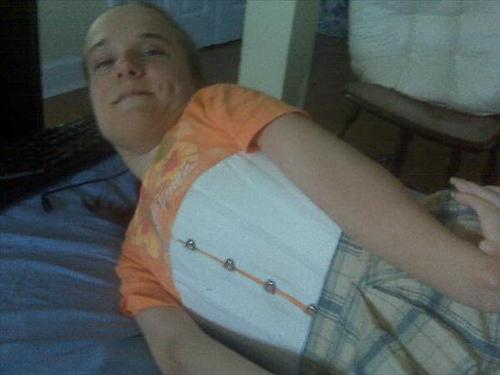
Ignore the bright orange t-shirt. I wasn’t dressing out or anything. I just put the corset on to make sure the new clothes were fitting right as they were being made. That’s the other thing. If you choose to have an 1860s corset, never give a seamstress your real body measurements or your dresses won’t fit right. Always do your measurements while wearing the corset. That’s true whether you’re disabled or not.
Adapting a corset for a disability is fairly easy. Buy one off the rack and wear it periodically for a few days (not 24/7 obviously). Don’t lace it too tightly, especially if you’re not used to wearing one. Pay attention to pressure points on your body throughout the day. Are you feeling pain in the corset? Are there abnormal red spots or bruises forming? These things need attention right away and were never normal, even back then. It’s a myth that 1860s women were tight lacing to the point of regularly breaking bones. That didn’t come until the end of the century. Worn properly, an 1860s corset can be quite comfortable and offer good spine support.
My pressure spots in my corset had to do with my ribs being misshapen due to my disability. The left side of my ribs jut forward while the right side of my ribs sink inward, causing breathing problems if I’m not careful. I didn’t think I could make a corset work safely but I wore it on and off for a few days to test it and I realized the pressure points were directly along the bones of the corset.
Corset surgery was required.
I cut the bottom seam enough to yank out the offending bone and presto. No more pain. Technically this is cheating because all bones should stay put but taking out a bone that fights your disability is a matter of survival. It won’t change the shape of your clothes much even if you take out two or even three bones. Good corsets retain at least some shape whether chock full of bones or not. Nobody notices I have a bone missing from my corset. Also, try cotton or moleskin padding between you and your corset for extra squish. It feels great.
Above all: do not tight lace if you are disabled. Your body will tell you when to stop. Don’t ignore it or you could really hurt yourself. Just lace it tight enough to keep it secure, like lacing up your shoes.
This was the first day I wore my current corset, before I took out the offending bone. You can see it didn’t fit right because the bones were fighting my body. I very nearly passed out. After removing the bone, I never felt discomfort again. Listen to your body!

Women portraying poor farmers or laundresses could get away with not wearing corsets but don’t expect to have a fancy ballgown either. If you portray the poorer class, you can’t just make yourself a gorgeous ballgown or fabulous silk walking dress too. Your clothing has to reflect the type of person you portray.
Fabric is another issue for me. Thin, slippery fabrics like various types of silk or organdy are hazardous because, to be blunt, my butt slides right off my wheelchair seat. I could pop right out on the ground on all that slippery fabric, so I use it sparingly. Only ballgowns, which are situations where I park in one spot and watch people dance and flirt with men who come to me. No moving around, and therefore, no popping out on slippery fabric.
However, limiting my use of silk to ballgowns presents a historical problem. Cotton (a more stable fabric) dresses were mainly used for work clothes like these that I made with my mother several years ago.
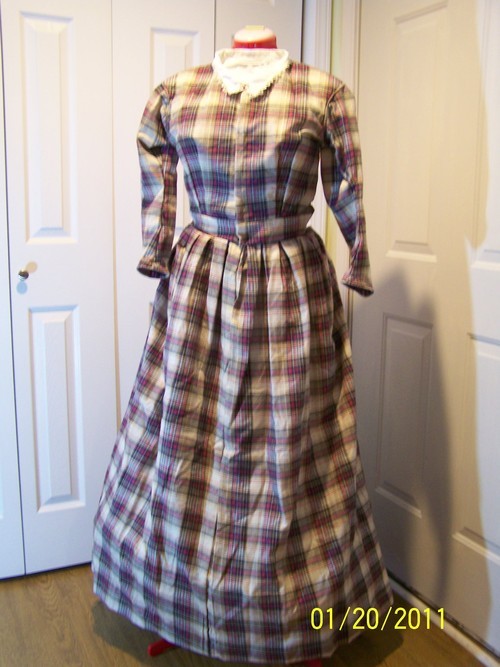
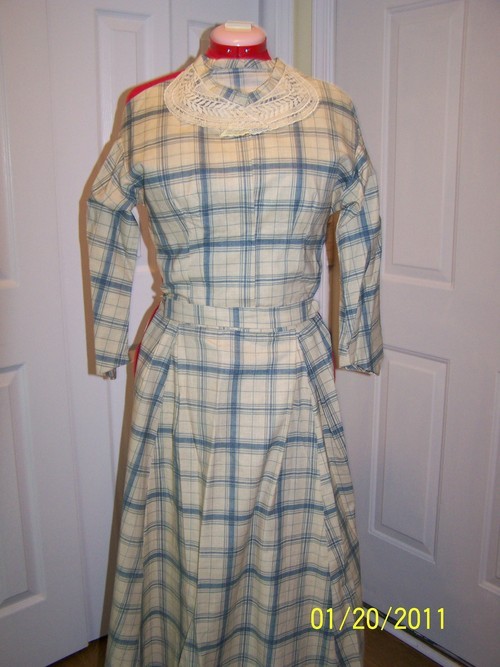
These are more or less correct to the period, though the collars are a little fancy for work dresses. The collars were my great grandmother’s though, so I just won’t budge on that.
I should also note that my sleeves look shorter than normal, not because I have three-quarter length or anything, but because my upper body is not proportioned quite right. The sleeves are short because my arms are short. My skirt widths are narrower than what is period correct in order to work with my wheelchair. I’ll get into that later. Again, customizing your attire around your disability is very important.
Now, these two dresses are a bit fancier. They look period correct to the naked eye but they’re not (I’m not too proud to admit that). Can you see why they’re not correct?
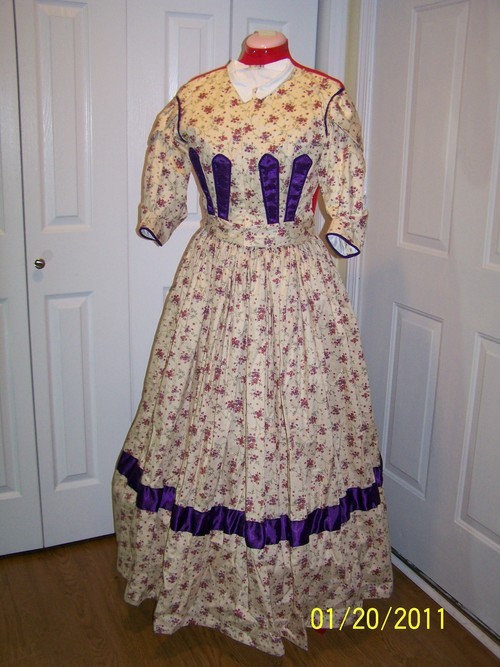
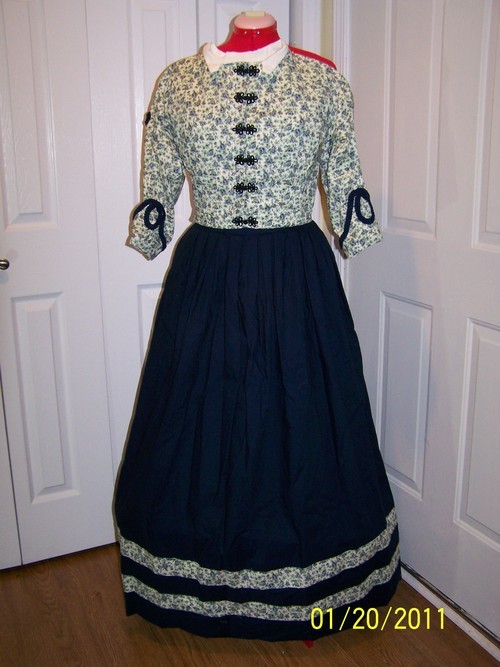
These dresses are considered day dresses. In other words, a woman would not be working in them. Really, they should be made of richer fabrics like silk, wool, or some blend of various things like that. Not cotton. However, the richer fabrics tend to be slippery, so I can’t use anything hazardous for me if I’m going to be rolling around all over creation. This is a situation where I have to adapt for my own safety even if it means not quite being accurate. (Also: the blue skirt not being all floral like the bodice isn’t accurate either but I ran out of fabric.)
People who have been reenacting longer may stop you and inquire about your choice of fabric if you avoid slippery things like I do for non-work dresses. It’s okay. They’re just trying to be helpful. Explain your reasons for making certain choices for the sake of your disability. Some may even know of more appropriate fabrics that are safe. Don’t be afraid to listen and learn.
The width of a skirt is an issue for disabilities as well. The Civil War was a period of ridiculously wide hoopskirts that are not at all conducive for those of us on wheels, crutches, or walkers. For work dresses, it’s not a problem because no sane woman of that period would work around a fire all day with a huge fire hazard around her legs. If you see a woman walking around a reenactment in a work dress with huge hoops, she ain’t gonna make it. She’d probably go up in flames back then. At the very least, working like that would be a huge pain. It’s just not correct.
This is the alternative:
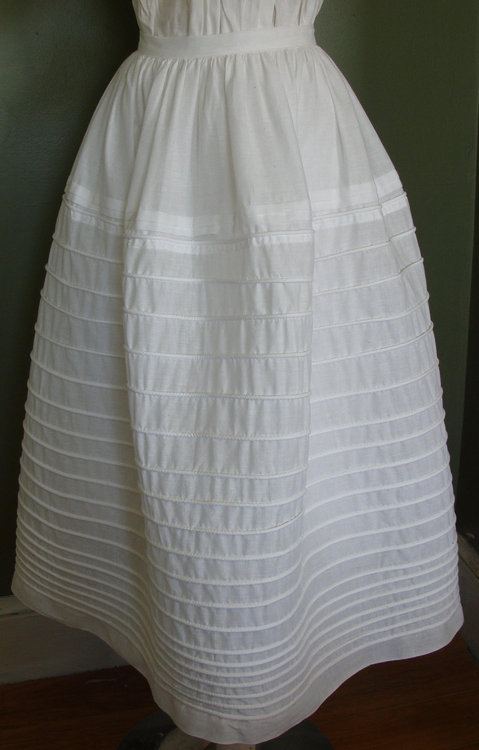
It’s a corded petticoat. It provides some fashionable width but it’s made of flexible material. This will save your persona if you’re in a wheelchair, using crutches, or using a walker. Again, we come to a crossroads of fashion vs. functionality because the nicer dresses, especially ballgowns, are supposed to require enormous hoops. Some of us just can’t do that. So people who roll their eyes at a lack of hoops or call you farby (slang for inaccurate) will have to suck it up.
If you can stand more width than corded petticoats provide but you need flexibility, do what they did before caged crinolines were invented. Layer your regular cotton petticoats underneath and on top of the corded petticoat. It gets heavy though, so experiment until you find the best solution for you.
Shoes can be very difficult if you have orthopedic issues like I do. I have clubfeet and I can’t wear more shoes than I can. It’s kind of a pain in the 21st century let alone the 19th century. Women’s everyday shoes in the Civil War were typically black boots that buttoned or laced up the side rather than buttoned or laced up the front. There was a bit of a heel as well, which I cannot do. In either case, I usually can’t wear boots in my correct size. My feet don’t bend and I just can’t get them into boots like these unless they’re two or three sizes too big.
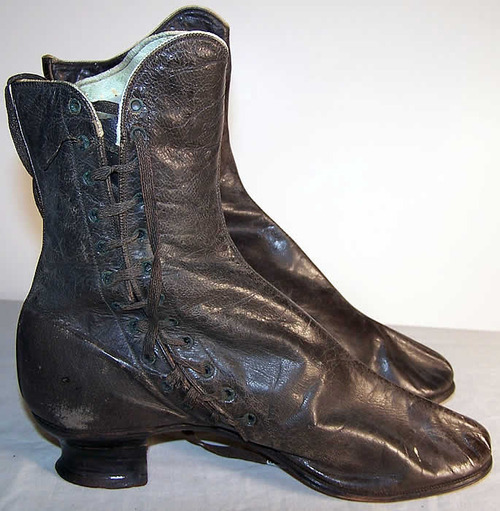
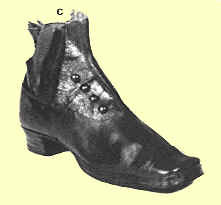
Reproduction boots for Civil War women often look something like this:

The reproduction boots are not as hard on my feet because they can be found without a heel and the loop thing makes it easier to pull it on my foot. As long as I order them too big, it works. The other trick is if you try it out in bigger sizes, you can create extra padding around your foot by putting on thick wool socks. Women wore cotton, linen, or wool stockings up to the thigh back in those days but nobody’s going to see it if you put on wool socks for padding over your stockings.
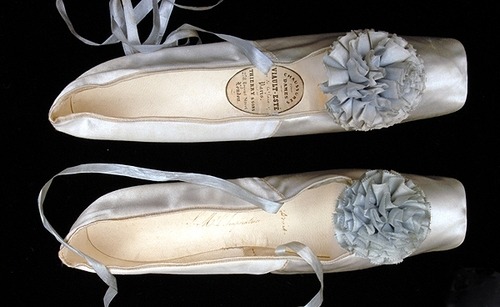
Another option if you really can’t get your feet into boots is to try the dancing slippers. These kinds of shoes were worn for formal evening occasions but they are softer and more forgiving than boots. This may be an area where you have to choose between survival and historical accuracy. Slippers in this style might be more comfortable for you.
If you have to cheat and wear modern shoes, it’s not that bad. Your dress is going to cover your feet anyway. I last a lot longer out there if I wear modern shoes with more padding and a better fit. My advice is to go someplace like Walmart or Target and look for something very plain and preferably black. Avoid tennis shoes if it’s at all possible.
Getting around with a disability in a natural terrain can be difficult too. I strongly advise that you never go anywhere by yourself unless there are paved sidewalks, and there are almost never any kinds of pavement anywhere at these events. Sometimes there are gravel or dirt paths, which I stick to if I can. Safety is the most important thing, so don’t be too proud to recognize your own limitations. Don’t avoid your medications. I keep mine in an old pillbox to keep up the Civil War illusion. I have a canteen for water too so I can stay hydrated without carrying around plastic water bottles.
Most of the time I don’t stay overnight unless I bring my own quilts and stuff because sleeping on the ground is really tough on my body. When I do stay overnight, it has to be plenty warm and I build a bit of a nest out of quilts for some padding between me and the ground. Some people bring an air mattress and cover it over with old-fashioned bedding to disguise it. These people do get eyerolls (reenactors will deny eyerolling but I’ve seen it happen) for being farby sometimes, but if you have a disability, they’re not going to eyeroll at you. A third option is to stay overnight in a nearby motel. These people are known as the Motel Brigade among some. I keep up the historical impression by not watching TV and sleeping in Civil War underthings.
The majority of reenactors are very kind and helpful. I highly doubt I’d ever wander around an event unescorted even if I wanted to because the soldiers especially will walk with me wherever I go. This is probably because of my wheelchair but it’s actually historically appropriate. Women almost always had male escorts out in public.
My point is, this is very helpful when you’re trying to negotiate rough terrain in a wheelchair. I do not recommend going to a reenactment alone. You need to attend with family or friends who know how to look after your needs. Lucky for me, I get my companions into it and they end up becoming reenactors too. My mom does the persona of a nurse, which fits our situation quite well.
Getting around rough terrain. If I can get up to the 20th Maine monument on Little Round Top in my wheelchair, you can handle rough terrain at reenactments too.

The terrain is not as scary as it looks. If you have a wheelchair with six wheels or the large wheels up front, you’ve got an advantage. When you’re wandering a reenactment, pay very close attention to the ground in front of you. Wheelchair accidents happen because people go too fast or they’re not watching the ground. Just accept that you’ll have to go slower than walking pace but you will get there! Little wheels up front make you less stable in dirt or grass or gravel, but there are some tricks.
- Have someone grab the front of your wheelchair and lift it up a bit to get over rougher spots.
- Take shallow holes or minor drops in the terrain on an angle instead of head on.
- Take deeper holes or drops in the terrain backwards (i.e. always use the bigger, dominant wheels when you need more stability).
- Park in central locations and stay put whenever possible. People will come to you.
- Avoid mud. It’s slippery. It’s bad. I once slid on mud, hit a boulder, and broke my knee. Fun times.
- Rule of thumb: it’s better to tip over backwards than it is to tip over forwards. If a hill looks steeper than you like, never fear. You can do it. Go down backwards with somebody behind you. I have never, ever had an accident that way.
- Do not load stuff on your upper chair. It makes you top heavy and increases your risk of sliding or tipping over. Bottom heavy wheelchairs are much more stable.
- Find a guy with a lantern or flashlight if you’re headed out at night. NEVER attempt wandering rough terrain in the dark.
I hope these tips have been helpful! Please do not hesitate to ask if you need advice on things I forgot to cover. I can usually invent a way to deal with any difficult situation.
Read More










 Today a lot of disabled protesters were arrested for protesting the proposals in the new health care bill at Senator McConnell’s office. This statement explains why, posted by ADAPT, the organizers.