

Kensington Palace Ghosts

Posted by Jessica Jewett 1 Comment »

>

Since news broke that the Duke and Duchess of Cambridge have decided to move into Kensington Palace while they are in London (their primary home is still the cottage in Angelsey, Wales), I decided to look at the history of the palace. We all know it as the place where Princess Diana raised Prince William and Prince Harry as boys but the history extends about three hundred years before then.

Kensington Palace has been used as a residence of the British royal family since the 17th century. It is divided into several different apartments. Currently, it is the official London residence of the Duke and Duchess of Gloucester, the Duke and Duchess of Kent, Prince and Princess Michael of Kent, and the Duke and Duchess of Cambridge. In the past, it has also been the official London residence of Diana, Princess of Wales, Princess Margaret and Princess Alice until their respective deaths.

Here is a bit of history on Kensington Palace from Wikipedia:

The original early 17th-century building was constructed in the village of Kensington as Nottingham House for the Earl of Nottingham. It was acquired from his heir, who was Secretary of State to William III, in 1689, because the King wanted a residence near London but away from the smoky air of the capital, because he was asthmatic. At that time Kensington was a suburban village location outside London, but more accessible than Hampton Court, a water journey on the Thames. A private road was laid out from the Palace to Hyde Park Corner, broad enough for several carriages to travel abreast, part of which survives today as Rotten Row. The Palace was improved and extended by Sir Christopher Wren with pavilions attached to each corner of the central block, for it now needed paired Royal Apartments approached by the Great Stairs, a council chamber, and the Chapel Royal. Then, when Wren re-oriented the house to face west, he built north and south wings to flank the approach, made into a proper cour d’honneur that was entered through an archway surmounted by a clock tower. Nevertheless, as a private domestic retreat, it was referred to as Kensington House, rather than ‘Palace’. The walled kitchen gardens at Kensington House supplied fruits and vegetables for the Court of St. James’s.

For seventy years, Kensington Palace was the favoured residence of British monarchs, although the official seat of the Court was and remains at St. James’s which has not been the actual royal residence in London since the 17th century. Queen Mary died of smallpox in Kensington Palace in 1694. In 1702 William suffered a fall from a horse at Hampton Court and was brought to Kensington Palace, where he shortly died. After William III’s death, the palace became the residence of Queen Anne. Sir John Vanbrugh designed the Orangery for her in 1704, and a magnificent baroque parterre 30 acre (121,000 m2) garden was laid out by Henry Wise, whose nursery was nearby at Brompton (illustration, left). Anne also had Christopher Wren to complete the extensions that William and Mary had begun, resulting in the section known as the Queen’s Apartments, with the Wren staircase, known as ‘The Queen’s Entrance’, which currently serves as the exit point, with shallow steps so that Queen Anne could walk down gracefully.

George I spent lavishly on new royal apartments from 1718. William Kent painted a staircase and some ceilings. In 1722 he designed the Cupola Room, the principal state room, with feigned coffering in its high coved ceiling; in 1819, the Cupola Room was the site of the christening of Princess Alexandrina Victoria, who had been born at Kensington, in the apartments of the Duke and Duchess of Kent (the actual room being what is now the North Drawing Room).

The last reigning monarch to use Kensington Palace was George II. For his consort, Charles Bridgeman swept away the outmoded parterres and redesigned Kensington Gardens in a form that is still recognizable today: his remaining features are The Serpentine, the basin called the Round Pond, and the Broad Walk.

After George II’s death in the palace in 1760, Kensington Palace was only used for more minor royalty, including the young daughter of the Duke of Kent who was living in the Palace with her widowed mother when she was told of her accession to the throne as Queen Victoria. Queen Mary (grandmother of the present Queen) was born at Kensington Palace in 1867. Her parents, the Duke and Duchess of Teck, were living at the palace. Edward VIII called the palace an “aunt heap” because of the number of royal relatives residing there.

It is not so commonly known that Kensington Palace is very haunted by its past residents. In my research, I actually found a lot of tourists on message boards who described the palace as having a heavy atmosphere for no apparent reason. A few people went as far as to suggest that Princess Diana’s self-destructive problems were aggravated by living in a palace so haunted by unhappy, negative ancestors. Only Princess Diana could shed light on that suggestion but unfortunately she is no longer with us.

The most commonly known identified ghost of Kensington Palace is King George II. He was the last foreign born King of England and died in the palace in 1760 of a ruptured right ventricle from an aortic aneurysm, a cause of death most likely brought on by syphilis. At the time of his death, he was waiting for news from his native home of Hanover but messengers were delayed by bad weather. He died staring out of the window at a nearby weather vane asking, “Why don’t they come?” over and over again. It is said that his face has manifested many times looking to the weather vane. Some hear his voice in a German accent asking, “Why don’t they come?” In my opinion, this is most likely residual activity – an imprint of energy from a specific event replaying over and over again – because George II has never been reported to have interacted with the living or even seem aware that any living people are there.

The great-granddaughter of George II, Princess Sophia, is also alleged to haunt Kensington Palace. This princess lived a very difficult life, never allowed to mix with people outside of the royal court. It has been debated that she engaged in an incestuous relationship with her brother, the Duke of Cumberland, but nothing was ever substantiated. It is also said that Princess Sophia fell in love with a man named Thomas Garth, who was her father’s chief equerry. There are some reports that she gave birth to an illegitimate child in 1800, either fathered by the chief equerry or the Duke of Cumberland. Regardless of the validity of these reports, Princess Sophia never married and her life was rather lonely. She found solace in her spinning wheel, but as her old age made her go blind, she wasn’t even able to do that anymore. Today, people in Kensington Palace have reported hearing the sound of a spinning wheel throughout the palace where there is no spinning wheel. The princess may still be carrying out her lonely existence and comforting herself with her favorite hobby long after her death.

Queen Mary II, wife of King William III, apparently haunts the Queens Apartments in Kensington Palace where she died in 1694. She was a very tall queen for her time, standing at 5’11, making her taller than most men in her life as well. She was responsible for many improvements to the palace until she contracted smallpox at the age of 32. Her kindness made her send away anyone in the palace who had never been exposed to the disease before as to prevent them from catching it. Her death in December 1694 devastated the King, who fell from a horse in 1702 and died in the same palace. Today, the Kings Apartments and Queens Apartments open to the public as the combined State Apartments. Mary II’s ghostly activities certainly preside over any renovations and improvements made to the palace in death since it was her husband who first purchased the palace. Some stories say Mary can be heard weeping for the children she never had and the short life she lived.

The grounds of Kensington Palace are haunted as well. A man in white breeches has been seen walking around and then disappearing into thin air. Nobody knows who he is but most of the unknown ghost stories in royal palaces throughout the world are attributed to the thousands of unnamed servants who attended royal families in history.

If you are lucky enough to be in London for Halloween weekend, you may choose to go on what the Kensington Palace website calls the Eerie Evening Tour. From the website (click here – http://www.hrp.org.uk/kensingtonpalace/WhatsOn/EerieEveningToursofEnchantedPalace.aspx):

Does Queen Mary weep in the Room of Sorrow for the babies she never had? Does Peter the Wild Boy still run amok in the Room of the World? Who stands at the window waiting for the ships from home?

As you are guided through the shadowy world of Enchanted Palace in the State Apartments, you will be regaled with chilling tales of mysterious sights and strange stories in our new Eerie Evening Tours of Enchanted Palace. Book yourself on these limited and exclusive tours in order to enjoy the unique atmosphere of historic Kensington Palace at night.

The Eerie Evening Tours of Enchanted Palace will run over the Halloween weekend – Friday 28, Saturday 29, Sunday 30 and Monday 31 October 2011 only. There will be one tour per night 18.45h – 20.15h. The price will be £20.00 per person and tickets will go on sale soon. There will be a maximum of 25 places per tour.

Please note that Enchanted Palace has limited accessibility – please see here for full details.

Not recommended for under 12s.

Further information

The Eerie Evening Tours of Enchanted Palace will run over the Halloween weekend:
Friday 28 October 18.45h – 20.15h
Saturday 29 October 18.45h – 20.15h
Sunday 30 October 18.45h – 20.15h
Monday 31 October 18.45h – 20.15h

There will be only one tour per night with a maximum of 25 places per tour. Not recommended for under 12s.

The price will be £20.00 per person.

Do keep an eye on this page as tickets will go on sale soon.

Read More

Hauntings of commercial airlines

Posted by Jessica Jewett 4 Comments »

>

The McDonnell Douglas DC-9-30 on the left looked like any other aircraft found in the skies in the 1960s. Except this plane would become the infamous Allegheny Airlines flight 853 that crashed en route from Boston to St. Louis in 1969. It collided midair with a Piper PA-28, killing over 80 people. There were no survivors and it was the worst air crash in history up until that time. The aircraft were both destroyed by the collision and ground impact to the point where no single body was left whole. It became clear in the recovery efforts that not everything was going to be found, so the decision was made to bring in dirt to, in effect, bury the entire crash site and prevent the spread of disease from rotting body parts. Time passed and the crash faded into memory but the people who were killed that September day lingered.

I first became interested in the Allegheny Airlines flight 853 crash when I watched a segment about it on the show My Ghost Story. Two paranormal investigators went to the crash site in Indiana numerous times, which is just a field with a mound where the wreckage and body parts were buried, in hopes of communicating with anyone who might have been left behind. The piece of evidence that grabbed my attention the most was when a female investigator theorizes something to the effect of, “Maybe he doesn’t know he’s dead,” and a male whispering voice replies, “Did we crash?” I find this interesting because this is a classic case of what some of us call Sudden Death Syndrome, which means if your death is quick and unexpected, you might get shoved out of your body so fast that you’re not aware of it. This is a very common phenomena among soldiers who were killed and haunt the battlefields where they died. The investigators also claim to have communicated with a female flight attendant who was supposed to get married not long after the flight, by use of dousing rods. They have also claimed to have communicated with a male crash victim who refuses to move on because he’s terrified of going up (toward what he thinks is heaven) only to fall to the earth again. It appeared from the wreckage that the Allegheny crash was virtually instantaneous. A severed hand was found holding a card as if the crash interrupted a card game. A paper was also found with the word “dear” and then an R with a sharp line as if the crash interrupted a few words to a loved one. Most of the 82 victims are probably not aware that they have been killed.

Looking into the Allegheny crash got me curious about other paranormal activity associated with aircraft. A lot of the stories appear to be urban legend to me, meaning there are three or four stories that jump from airline to airline with no real origin, but there are some interesting things as well. As I dug through various aviation forums, I saw more than one employee from more than one airline say that they are unofficially not allowed to talk about anything paranormal associated with their jobs and airlines will fire them if they do. What’s interesting, though, is that they are talking about it anonymously. I have also found that airline employees are very efficient, skeptical, intelligent and credible, so when they say, “This is what happened….” I find it believable, especially if they could get in trouble for telling the stories. I tried to find conclusions as to why there are paranormal things happening on aircraft and I found one common thread through all of it. Wreckage from plane crashes are salvaged and fitted out on other aircraft still in use or being built at the time in order to save resources. So you have pieces of aircraft that absorbed the violence of the crash and the massive expenditure of terrified energy from dozens or hundreds of passengers dying simultaneously being used on other aircraft. That is one of many ways to cause a haunting.

The most infamous case of an aircraft haunting caused by recycled parts from crashes was that of Eastern Airlines Flight 401. Eastern Air Lines Flight 401 was a Lockheed L-1011 Tristar 1 jet that crashed into the Florida Everglades on the night of December 29, 1972, causing 101 fatalities (77 initial crash survivors, two died shortly afterward). The crash was a result of the flight crew’s failure to recognize a deactivation of the autopilot during their attempt to troubleshoot a malfunction of the landing gear position indicator system. It is believed that fatigue and poor crew resource management (CRM) contributed to the accident. As a result, the flight gradually lost altitude while the flight crew was preoccupied and eventually crashed. It was the first crash of a wide-body aircraft and, at the time, the deadliest in the United States.

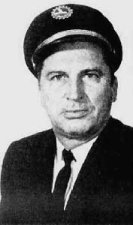
After the crash, salvaged parts from the L-1011 were installed in another L-1011 plane (the N318EA) as well as a few other planes and sightings of crew members began from there. Specific sightings of Captain Bob Loft and Second Officer Don Repo (pictured at right) became so common that even skeptics began to believe it. Repo in particular was often seen in the cockpit and the galley where flight attendants prepared meals for passengers. He was an unusually solid-looking apparition and was always very concerned about flight safety, for obvious reasons. All L-1011 planes were thought to be looked after and protected by him. As for Captain Loft, I found this story: “Loft’s ghost was also seen on various flights, usually sitting in first class or in the crew’s cabin. A stewardess once confronted Loft, asking what he was doing on the plane as she had not seen him board and could not identify him on the passenger manifest. Receiving no reply, she reported it to her flight captain. He walked back with her and recognized Loft, who disappeared immediately in front of a dozen people.”

The sightings were all reported to the Flight Safety Foundation (an independent authority) which commented: “The reports were given by experienced and trustworthy pilots and crew. We consider them significant.”

That type of haunting is a couple of men who were at fault for the crash, knew they were at fault moments before impact (flight recordings reflect this), and the guilt of what happened is keeping them attached to the plane parts. The sightings frightened so many Eastern Airlines employees that the airline was forced to deal with the situation by trying to put a lid on it, suggesting that the employees seek psychiatric help at the airline’s expense. Officially, the airline never believed the encounters with Repo and Loft, but it should be noted that every single flight 401 salvaged part was removed from the airline’s fleet of aircraft. Interesting reaction from an airline that told their employees to get psychiatric help, isn’t it?

I wanted to post an anonymous story that I collected from an aviation forum where a lot of airline employees chatter amongst themselves. Like this person, I wondered if the 401 stories were true because of how infamous they were but if this person really met someone who personally witnessed it, then others have too.

Everybody has their take on 401, including me. Personally, I thought it was one of the most overhyped, dramatized, nonsense components of aviation folklore that has ever appeared. That impression had been mostly maintained until about two years ago, when an interesting part of this story happened to enter my ear via a most unexpected place.

While working on the line several years ago for a different airline than I do now, I had the pleasure of meeting an older employee by the name of Jessica who worked in our operations division. Although having not worked with her day in and out, my impression and the impression of several of my peers was that of a very competent, professional, focused person. She had no time for nonsense, would call people on theirs, and even less patience for those who did not do their own weight, so to speak. If you saw her during the course of your paperwork, you could quite literally be guaranteed that signaled a positive change in moving things in the right direction.

When a snowstorm brought ATL to its knees in January of ’02, many crews, including myself, were stuck in ops waiting for a definitive answer as to whether or not we would be getting a green light or getting our entire trip canceled. Jessica happened to be there, and we began small talk about a number of things to pass the time. During the course of conversation, we were talking about more of the absurd things that have happened in aviation, like say running out of deicer fluid or having runoff tanks that get full with rainwater in them.  About twenty minutes later, she happened to mention she worked for Eastern Airlines, and had seen more than a few interesting events in her time.

Much like the poster above, I sarcastically asked her “So, got any ghost stories from 401 to tell”, and after getting a chuckle out and expecting the same, she smiled, turned her head down, and started off with “Well…”.

For about two minutes and with little exaggeration, a group of professionals around her, including myself, turned into the proverbial kids around the bonfire. Straight faced, without pause, and without joking, Jessica recounted when she was working with EA having started out a aircraft cleaner in Atlanta who worked the overnight shift in the early 1980s. She explained that one of their tasks would be to clean the aircraft in the Maintenance base and gates overnighting, which included L-1011s. She had said many of her coworkers would use that shift to pretty much take naps for the majority of that time ( I had spoken to a family member who used to work for them on another matter separately before this who verified they were indeed notorious for that) but said she was raised that if you are paid to do a job, you do the job, and would actually do it, and that most certainly fit Jessica to a T.

During one of those overnight shifts in the summer, Jessica said she had boarded an L-1011 (I believe she had said it was indeed the ubiquitous 318 but don’t quote me on it) and began cleaning the aircraft along with the crew to which she was assigned. Upon entering the lower galley area of the aircraft to clean it, she noticed immediately was that its was cold to the point of nearly frigid, and couldn’t figure out how in the world that could be considering this was Atlanta, and in the middle of a summer night no less. Jessica began cleaning the galley, as well as a cleaning of the ovens that she described in detail, though I don’t remember it in exacting specifics. Upon glancing into the reflection of one of the galley oven glass doors she saw the reflection of a person behind her in uniform and looked back for the person who she had not expected to see there. She didn’t see anyone, looked back into the glass, saw the reflection again, and, mildly paraphrasing, moved like lightning and bolted off to her crew lead. Afraid he would think she was crazy, but not caring, she asked him “What the hell was that???” “What the hell was what?” her lead asked. She told him what she had seen. “Oh yeah, that, you’ll see that from time to time.” Jessica was so dumbfounded from the response she got from her lead that she began asking around to other crews when getting the chance. She got the whole story on the 401 parts thereafter, and said she never went into another L-1011’s galley because of that happening.

Maybe you’d have to know Jessica, and I’m certainly not saying that the other things surrounding 401 were legitimate, but let’s just say that is one time more than a few people were wandering about, and not doubtfully.

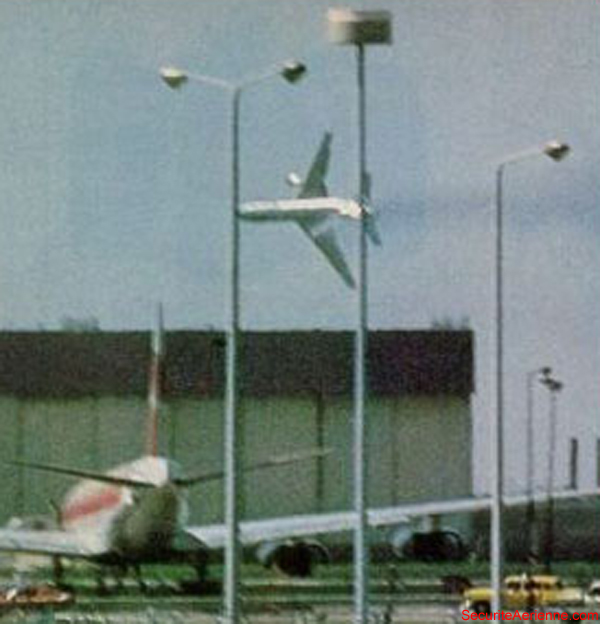
Pictured at left is American Airlines Flight 191 banked completely sideways moments before it crashed in May of 1979. The DC-10 aircraft was scheduled to make a nonstop flight from Chicago to Los Angeles that day, but upon takeoff, part of the port engine pylon fell away from the aircraft and a “white vapor” emanated from the area. As it rose, the entire engine and pylon tore loose from its mounting, flipped up and over the wing and crashed down onto the runway. The tower asked if 191 wanted to come back but there was no reply. Instead, the plane climbed to 300 feet and then banked left slowly at first, then quite sharply until the wings were vertical. At that point, the plane literally fell from the sky and exploded in a massive fireball. Two people were killed on the ground and all 271 passengers and crew members were killed instantly.

The strange activity began within hours of the crash as residents in the neighboring mobile home community reported hearing knocking and rapping on their doors and windows. Many of these residents were retired police and firemen who said no one was there when they answered the doors and looked out the windows. This continued for weeks and months and even escalated to the point that doorknobs were being turned and rattled, footsteps were heard approaching the trailers, clanging on the metal stairs, and on some occasions, actual figures were confronted. According to some reports, a few residents opened their doors to find a worried figure who stated that he “had to get his luggage” or “had to make a connection” standing on their porch. The figure then turned and vanished into the darkness. Within a few months of the tragic crash, people on the roads near the crash site began calling the Chicago police to report strange white lights bobbing up and down in the field. People thought they were souvenir hunters but the police always found the field deserted and silent.

From a paranormal website:

The tragedy, and the strange events that followed, caused many of the residents to move out of the park but when new arrivals took their place, they too began to report the weird happenings. A fairly recent sighting was described by a man who was walking his dog one night near the area where Flight 191 went down. He was approached by a young man who explained that he needed to make an emergency telephone call. The man with his dog looked at this person curiously for he seemed to reek of gasoline and also appeared to be smoldering. At first, he just assumed the man had been running on this chilly night and steam was coming from his clothing, but when he turned away to point out a nearby phone and then turned back again — the man had vanished! The man with the dog had heard stories from other local residents about moans and weird cries emanating from the 1979 crash site but he never believed them until now. He was now convinced that he had encountered one of the restless passengers from Flight 191 for himself!

And he’s likely not the only one, for the stories of weird knockings, inexplicable sounds and even apparitions continue to this day. One long-standing incident, which is often repeated, comes from the terminal at O’Hare itself. According to travelers, many have purported to see a man making a telephone call from a booth that is located close to the departure gate that was used by Flight 191. Those who have seen him say that is quite normal-looking, except for the fact that his business attire seems oddly out of date. He allegedly steps away from the telephone booth, manages a few steps and then vanishes into thin air. Is he one of the doomed passengers from Flight 191 — or another phantom altogether?

There are smatterings of other stories told by airline employees in aviation forums. Most of the stories involve passengers who have died while on flights. I also noticed that there have been quite a few stories of engineers lingering around planes they worked on a lot, as well as flight attendants who frequented certain planes more than others. The stories are not limited to Americans either. There are stories from airlines all over the world, suggesting that there is something legitimate happening with paranormal activity surrounding air travel. It’s not surprising if you think about it. Aside from tragic and horrifying crashes, people expend a lot of emotions when they travel. The expenditure and heightening of emotions leave behind energy that can easily become active hauntings if the conditions are right.

Think about all of the flights you have taken in your life. Have you ever experienced anything a little out of the ordinary?

Read More

Ghosts of the Dakota building

Posted by Jessica Jewett 9 Comments »

Today, the Dakota building in New York City is famous for being the last home where John Lennon lived and for being the site of his horrible murder, but this building has a long and detailed history of paranormal activity. Even Lennon himself, who was open to the paranormal, witnessed a UFO from the window of his apartment and also encountered the apparition of a woman walking down the long halls of the building, who he named the Crying Lady Ghost. Other celebrities and notable figures who have lived in that building have also had very similar experienced. Maury Povich described the building as “very haunted”, for example.

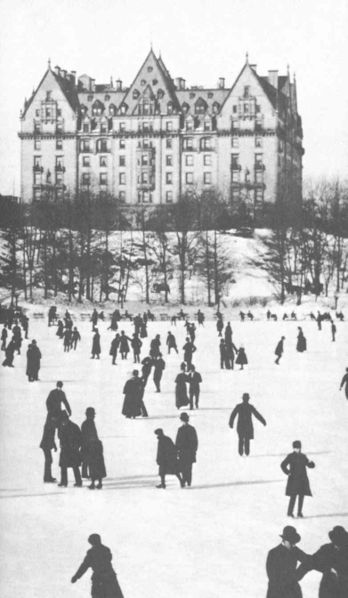
Standing at Central Park West and 72nd Street, the Dakota was built across from Central Park by Edward Clark, who was head of the Singer Sewing Machine Company, between 1880 and 1884. In those days, the Dakota was so far removed from the city that there were no other buildings around it. The architecture was a mix of German Gothic, French Renaissance and English Victorian, with high gables, terracotta features, gargoyles and exotic decor, giving it an imposing appearance even for it’s time. The name “Dakota” in reference to this building first appeared in a 1933 newspaper and came about because of Edward Clark’s interest in the Western territories. The building contains 65 co-op apartments and no two are alike.

The Dakota in the 1880s from Central Park.
The Dakota in 1890.

The Dakota has had a long history of being haunted, going back to stories from the 1960s, if not earlier. In the 1960s, construction workers reported seeing the apparition of a young man’s body with a young boy’s face. Several years later, reports surfaced of a little girl in turn-of-the-century clothing appeared to painters working in the building as well. This little girl seems to be the most frequently witnessed apparition and is always quite friendly, often smiling at people and approaching them as if to greet them.

Some of the stories I have collected about the Dakota:

The Little Girl – Painters working in the hall saw a girl with long blonde hair and dress of an earlier time bouncing a ball. None of them saw her before and she didn’t fit descriptions of children who lived there or of guests. A woman, waiting for a friend in the foyer, saw the same apparition who walked into what she thought was an adjacent room. Later, she discovered it was a closet and she had seen the “ghost-in-residence” by others who sighted her.

Judy Holliday’s Dakota Apartment – In 1965, after her death, the Smiths bought the apartment. They hired three men to repaint walls and re-varnish woodwork. The workers felt they were being watched. One saw a ghost of a boy of about 10 dressed in a Buster Brown suit, a style of the early 1900s. A musty odor accompanied the apparition. The three saw a ghost that had the body of a male in his 20s and a face of a young child. After the job was done, one of the painters was doing some touch-up work in a large closet. Suddenly, the door slammed and the light went out. He groped his way off the ladder, propped the door open and turned the light back on. He felt something grab his arm and put it against the light bulb.

Third Floor Dakota Apartment – Frederick and Suzanne Weinstein have heard footsteps and other noises in their home. In the dining room, other paranormal phenomena happened. Rugs and chairs slid on their own. One day, when Weinstein was coming home, he saw, through his living room window, a large crystal chandelier, lights aglow, although none had been there. He thought Suzanne had it installed as a surprise. When he went into the living room, there was no chandelier, although bolts for one remained.

Basement in the Dakota – The porter summoned tenant Wilbur Ross to the cellar because a heavy snow shovel flew off the wall and nearly hit him. He showed him garbage that was thrown about, explaining the bags began to move of their own volition. Ross was skeptical until a metal bar flew across the room, landing by his feet. He tried to pick it up, but it was too heavy. Other tenants had similar experiences. An electrician, working in the basement, saw the ghost of a short, long-nosed man with a beard, no mustache, wire-framed glasses and a wig, wearing a frockcoat and high hat. Later, others sighted the same apparition. The description matched that of Edward Clark.

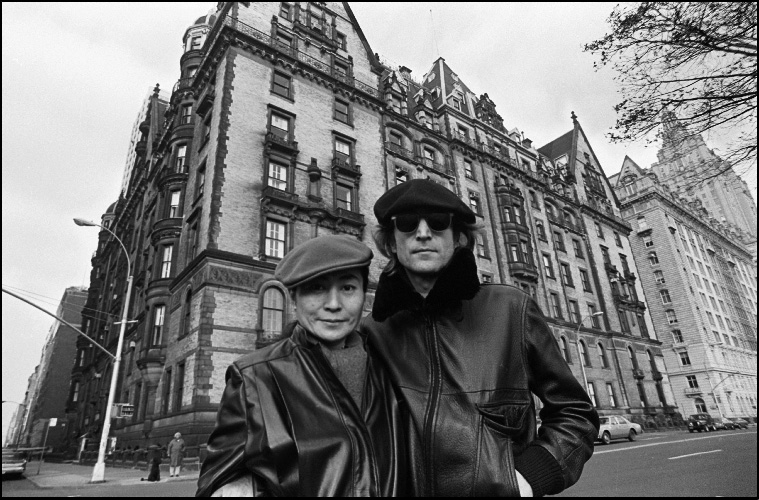
John Lennon – In 1983, Joey Harrow, a musician who lives near to the Dakota Building, claimed he saw John’s ghost in the Dakota entrance doorway, the spot where he’d been shot three years previously. “He was surrounded by an eerie light,” he claimed. At the time of the sighting he was accompanied by a writer called Amanda Moores, who confirmed that she had also seen the ghost. “I wanted to go up and talk to him, but something in the way he looked at me said ‘No’,” she said. John’s ghost had been reported by various other witnesses who claimed it had been haunting the Dakota. Psychic Shawn Robbins said she saw John’s ghost in the building and Yoko Ono herself was reported to have seen John sitting at his white piano. He turned to her and said, “Don’t be afraid. I am still with you.” According to several Spiritualists, John’s spirit lingered on Earth for a short time before a group of spirit Guides helped him to adjust to the ‘other’ world. A person who won’t ‘let go’ after they are dead becomes a ghost who haunts the area of the tragedy. The Guides convinced him to join them in the spirit world and various Mediums began receiving messages from him. Lennon periodically makes visits to the Dakota still.

Yoko Ono and John Lennon outside of the Dakota.
Read More

Categories